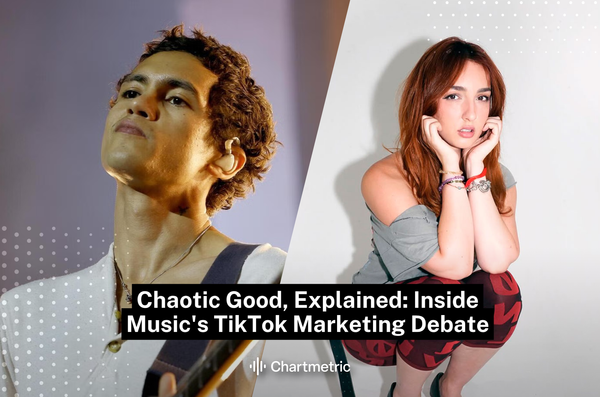

Brooklyn alternative rock band Geese has been making headlines since the release of their lauded fourth LP, Getting Killed (2025). But an unwelcome headline came from Wired this past April. It read:
“The Fanfare Around the Band Geese Actually Was a Psyop.”
The deleterious term “psyop” was attached to a marketing agency called Chaotic Good Projects, of which Geese was a client. Roughly three weeks before the article, Jesse Coren and Andrew Spelman, co-founders of Chaotic Good, went on Billboard’s podcast, On The Record, to share the campaigns they’ve led for notable clients such as Geese, Laufey, Wet Leg, Alex Warren, SOMBR, and Dijon.
Overall, Chaotic Good’s approach largely focuses on TikTok. They engage in traditional methods, like hiring macro influencers to make a post with their client’s song. They also have a massive network of accounts that will make videos with their clients’ music in order to simulate virality.
However, another type of campaign caused the uproar. It’s called a “narrative campaign.” This employs the network of accounts to not only post with music, but to enter comment sections of any post pertaining to the client to drive a story lauding their talent.
“Unfortunately, a lot of the internet is manipulation,” Coren said during the podcast. “All opinions are formed in the TikTok comments. Most people see a video about an album that came out, and the first comment that they see is their opinion even if they haven’t heard the whole album. It’s really important that we are controlling that narrative.”
The Wired headline was just one salvo in the bombardment against Chaotic Good and its clients following the interview. The Guardian and The Atlantic also published pieces dissecting the effect of these campaigns, not to mention the surfeit of posts decrying the practice. In the fallout, Chaotic Good cleared its website of all its clients, every service link redirects to a general email address, and the company’s Instagram now has zero posts.
One reason perhaps Coren was casual about explaining the process is that the host, Billboard Senior Correspondent Kristin Robinson, made it clear that other agencies such as Your Culture have been running similar campaigns. After all, TikTok has been an essential marketing tool for years now.
Nala, a fully independent dance music artist based in Los Angeles, brings up yet another key point to the discourse: “Artists have always been forced to promote in some way or another.” It makes sense that those who have the funds to hire such an agency will do so. But Nala, real name Stefania Aronin, cites the deception as why a narrative campaign would rub the music community so wrong.
“The second a consumer feels like they're being tricked, they immediately disengage. They absolutely hate it, and they hate the artist that engages in it,” Aronin explains. For her own self-promotion, she goes the direct route: putting ad spend behind social posts, such as those that include DIY videos she’s produced.
“Yeah, I'm advertising. I'm an artist, and I need to get my music out there. Versus trying to be a bit more coercive about it,” Aronin says. “I think people just hate feeling deceived, and I think that [Wired] article definitely pulled back a curtain.”
More than the fact that Geese worked with Chaotic Good, the band has such an authentic indie quality to their presentation. The band’s lead singer, Cameron Winter, also worked with the agency on his solo project. His most recent tour consisted of him on stage alone, singing incredibly vulnerable lyrics and playing piano. The outward image is very different to someone like Drake or The Weeknd, who are so big everyone would expect some kind of corporate or otherwise surreptitious intervention on their behalf.
“We come to artists, and specifically musicians, to be truthful and authentic,” Robinson says, speaking to Chartmetric. “It's also kind of the same thing as how you never want to hear that your favorite artist didn't write the song. You're like, ‘Wait, but I thought that was about your life? I thought we were relating, and now this is a karaoke song?’”
As jarring as it may be to discover an artist who seems so honest used such a marketing tactic, there is another unavoidable truth related to these campaigns: it is impossible to discern their efficacy externally.
If a major artist paid Chaotic Good $50 to hype up one social post, the company would still have them on their client list despite a frankly inconsequential effect on their career. Furthermore, there is no way to track exactly when a marketing campaign started or ended. For a campaign that includes posting numerous videos on different accounts, those posts stay on TikTok in perpetuity and could theoretically be shuffled around the algorithm until the end of time.
The data paints an inconclusive picture as well. A core aspect of a narrative campaign is comments on TikTok. Well, by comparison to other artists, Geese’s posts don’t have an overwhelming amount of comments. In a sample of 3836 artists with a similar number of followers to Geese’s 77.8k, the median number of comments per post is 23, which is listed in the “great” tier. That tier represents the second-highest numbers. The highest tier is “excellent.”
In terms of other Chaotic Good artists, Wet Leg is in the “average” tier for TikTok comments. Alex Warren, whose song “Ordinary” has surpassed 2 billion streams, far more than anything by Geese, is also in the “great” tier for TikTok comments.
“These campaigns don't always work. They actually usually don't work,” Robinson says. “The song has to be really good. So, it's like giving people more instances of hearing the song, and then maybe they're more likely to say that they like it by the end of hearing it for two weeks straight on their TikTok For You page.”
Then there is the consideration of whether successful social media campaigns actually lead to new fans who will listen to the music, buy merch, and spend their time at concerts. As Blue Dot Fever has suggested, a follower on social media and a fan willing to support the artist are often two very different things. To use Geese as another example, their Spotify monthly listeners are only in the “great” tier with 1.46 million. Their biggest song is “Au Pays du Cocaine with just over 30 million streams.
That is far below a song with any kind of real virality. Dominic Fike’s “Babydoll” is currently in the midst of a viral moment. In the last year, the song has gotten around 1 billion streams, now sitting at roughly 1.8 billion, up from 753 million. And yet, without any song nearly that popular, as of July 23, all but six of the 28 dates on Geese’s “Getting Killed Again Tour” are sold out. Three of them are in Los Angeles at the Hollywood Forever Cemetery, totaling 10,500 tickets.
The generally lower streaming numbers alongside impressive ticket sales suggest a smaller fanbase, but one that is willing to spend money. Could a TikTok comment really be all it takes to convince someone to buy a ticket as prices continue to increase?
There is another data metric also worth exploring in this regard: total posts. Chaotic Good didn’t discuss making posts for the artists on their native accounts, so these numbers are likely at the discretion of the artists and their direct teams. Many Chaotic Good artists are in even lower tiers when it comes to total posts. Dijon is in “below average. Wet Leg and SOMBR are both in “slightly below average,” and Warren is in “average.”
A plausible conclusion here is that these artists would likely rather focus on creating art than using social media. That’s why companies like Chaotic Good exist. Wouldn’t the fans prefer their favorite artists spend more time making music?
“Artists and people in the music industry will say, mostly in private to me, ‘Thank God there's another thing that we can do that doesn't require the artist to just have to make 10 TikToks a day,’” Robinson admits. “Historically, record labels, managers, etc, have always been around to try to help do all the legwork so that the artist has time to make art.”
Aronin is generally happy to make content because she has a longstanding creative team around her that includes a film crew and graphic designer. Moreover, as the head of her own label, Mi Domina Records, she enjoys leading the visual aesthetic that can attract other artists to become a part of the fold.
“I'm not really concerned about whether or not the algorithm's going to reward me for this,” Aronin says. “I'm focusing on visual, creative endeavors instead of micro-meme content. Which serves its purpose. Sometimes I do funny videos where I'll rant, or I'll post a meme-style thing, and it'll do well, and I don't have to put money behind it. But I have found ways to make my experience enjoyable.”
She has discussed different options for promotion with her fellow artists. Some of her peers have engaged with similar tactics as Chaotic Good, but the numbers she saw weren’t great to begin with. Now, after the Wired article, the numbers have been even worse.
“Sometimes artists forget that they are running a business. Where is my money going to serve me best? How can I do this within a reasonable budget and give these tracks the best shot that they can get?” Aronin says. “I actually do feel I've seen positive results from making the art with friends in a low-budget setting, and just pushing it with ads, because it does get eyes, and then those eyes lead to bookings.”
At least if the advertising is clear, no one can claim anything is a “psyop.” And perhaps this Chaotic Good spawned a larger cultural shift. Gen-Z historically gravitates towards authenticity. Burner TikTok accounts seemed more authentic at first because it wasn’t attached to an obvious ad campaign. But now that the curtain has been lifted on the practice, perhaps traditional ads will be seen as more authentic. When Nala puts money behind her new song, she’s not hiding anything. She’s sharing art she’s proud of.