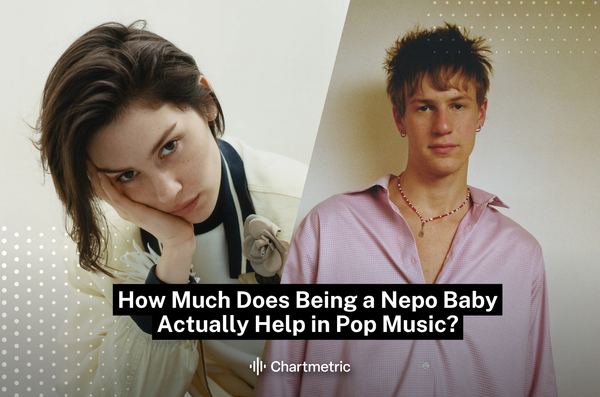

While the nepo baby discourse kickstarted by New York Magazine in 2022 initially focused on Hollywood actors, several well-connected musicians are also proving this year that it's not what you know, but who. Boasting a Gallagher, a Grohl, and even a Beckham on the line-up, flagship UK festival Reading and Leeds might as well have been renamed Privilege. Meanwhile, the current Hot 100 features hits from the offspring of a blockbuster director, Met Gala jeweler, and the 876th richest person in the world!
Obviously, music industry nepotism is nothing new. From Ziggy Marley and Julian Lennon to Natalie Cole and Jeff Buckley, the late 20th century witnessed a plethora of artists who first caught attention via their famous name. More recently, Clairo, Billie Eilish, Mabel, Maya Hawke, and King Princess are all said to have used their parentage to their advantage.
However, at the same time, the doors for those without significant financial or industry backing still appeared to be open. Now, thanks to the rising costs of hitting the road – average tour earnings have reportedly decreased by 45 percent – not to mention lower royalties, they’ve been slammed shut. Even the scene’s most vocal anti-capitalists are loaded, explaining why synth-pop singer Eli – whose dad is the multi-millionaire COO of a lucrative investment firm – received such a pushback after telling the Daisy Chain Festival crowd to “eat the rich.” Furthermore, this new dominant wave all seem to have reaped their rewards practically overnight. But does the data back this up?
Well, in the case of Gracie Abrams, arguably one of music's most prominent nepo babies, her audience has grown more steadily than you might think. The daughter of Lost co-creator J.J. Abrams, Gracie has earned two Grammy nominations and a Billboard 200 chart-topper along the way.
Her Spotify monthly listener rate, for example, gradually climbed up to 15.9M over the space of five years before 2024 sophomore The Secret Of Us took her career to another level, with Billions Club entries “I Love You, I’m Sorry” and “That‘s So True” powering this number to a high of 50M. Her Pandora monthly listeners (100.1K to 1.9M) and YouTube video views (11.4M to 90.6M) also experienced similar trajectories. Interestingly, this was also the period where her Wikipedia page views spiked from 85K to 706K as interest in her backstory skyrocketed.
One could argue that Abrams, admirably one of the few nepo babies to have acknowledged her privileged position (“I wasn’t growing up afraid financially, and that’s the biggest deal”), benefited from significant editorial playlist exposure early in her career. Before appearing on a single Billboard chart, she had already achieved a Spotify editorial playlist reach of 86.2M. Her 2019 debut single “Mean It” was quickly added to Herbst Chillout, which had 1.1M followers, while “Friend,” the opening track of her Minor EP, appeared on Chill Hits (6.4M followers) in 2021, when her popularity score was still a relatively modest 66. Nevertheless, editorial playlist support tells only part of the story. High-profile tour support slots with Taylor Swift and Olivia Rodrigo, alongside sync placements in young adult dramas such as Ginny & Georgia and The Buccaneers, may have played an even greater role in accelerating her rise.
Of course, Abrams’ background looks practically impoverished compared to that of Stella Lefty, whose father is Eric Lefkofsky, the Groupon co-founder with an estimated net worth of $6 billion. Lefty’s single “Boston” has been kept from the top spot on the Billboard Hot 100 only by Ella Langley’s juggernaut “Choosin’ Texas.” Her privileged background and rapid rise have fueled accusations that she bought her way to the top. If that’s the case, then she’s certainly bided her time.
While her Noah Kahan-interpolating smash may appear to have come out of nowhere, Lefty had actually been trying to break through for several years with little success. Despite building a sizable following on TikTok, where she amassed 4.4 million likes, that attention initially failed to translate into streaming success. Her Spotify monthly listeners struggled to surpass 100K, her popularity score remained in the single digits, and her editorial playlist reach was virtually nonexistent. That began to change earlier this year when “Thinking ’Bout You” gained traction. The subsequent success of “Boston” propelled her Spotify monthly listeners to 17.4 million, her popularity score to 80, and her editorial playlist reach to 108.6 million.
Singled Out (921K) was the first major playlist to bite, with morning glow (619K) and Chillax Ka Muna! (1.2M) following suit. Further proving the disparity between streaming and airplay, “Thinking ‘Bout You” has since racked up a total of 64.8M streams while being played just 16 times on US radio. In fact, only 213 spins have been recorded across the entire world.
Whether Lefty, who’s described the nepo talk as “unnatural,” is an industry plant or not, her immense wealth has no doubt given her the time to find this audience. Likewise, Sienna Spiro, whose high-end jeweler dad Glenn Spiro has counted everyone from Jay-Z to Jeff Bezos as clients.
Currently topping the UK charts with “Great Expectation,” Spiro spent her late teens showcasing her vocals on TikTok, amassing 487K followers before releasing her 2024 debut single “Need Me.” The track received a significant boost after being added to Spotify’s Chill Pop playlist (1.8M followers), although her monthly listenership remained below 3M. That changed in early 2026, when she was nominated for the BRITs Critics’ Choice award and “Die on This Hill” exploded on both sides of the Atlantic, sending her Spotify monthly listeners soaring to a peak of 31.2M.
Siblings Malcolm Todd and Audrey Hobert round out the nepo baby takeover of the Hot 100. Their father, Tim Hobert, worked as a producer on the now-defunct sitcom The Middle, although how much influence that connection carries in the music industry remains unclear. A similar question surrounds Lola Young, who has found herself caught up in the nepotism conversation simply because her aunt is children's author Julia Donaldson.
In Todd's case, his early career suggests that success was far from guaranteed. His initial releases made little impression, with songs like “In a Trance” only accumulating millions of streams after his breakthrough. Instead, his audience appears to have grown organically on TikTok, where he had amassed 20.8M likes and 505K followers by April 2025. That momentum eventually translated into his Billboard Hot 100 debut with “Chest Pain (I Love).”
Hobert, on the other hand, appears to have instantly benefited from her family tree, not to mention her working partnership with Abrams. Her debut single “Sue Me” was immediately placed on major Spotify playlists including teen beats (2.1M) and Pop Rising (3.2M), resulting in a rapid Chartmetric Rank rise from 309,162 to 2,894 in the space of a month. This exposure also helped to more than double her Instagram and TikTok follower counts and triple her Spotify across the following year, while all but two tracks from her debut album Who’s the Clown? have surpassed 10M Spotify streams.
Elsewhere, North West, arguably music’s most high-profile nepo baby as the daughter of Kanye West and Kim Kardashian (and having only just entered her teens, undeniably the youngest), already has a Spotify following of 221K. Collaborations with her troubled dad (“Talking”) and FKA twigs (“Childlike Things”) have inevitably attracted the majority. However, her entirely solo single “Piercing on My Hand” has accrued a respectable 4.6M streams, no doubt buoyed by playlist support from This Is Frequency (1.2M) and Most Necessary (2.7M).
Perhaps the most blatant recent example of nepotism came in June, when Will Ferrell played his son Magnus’ single “Asleep Talking” on former First Lady Michelle Obama’s IMO podcast. The exposure helped propel the track from 417K to 6.89M Spotify streams, while Magnus’ monthly listeners surged from 188K to 1.33M. By comparison, his 2021 single “Hold My Hand” has amassed just 5K streams.
Not every nepo baby has enjoyed the same success, however. Liam Gallagher’s son Gene, who has undoubtedly inherited the family’s signature eyebrows, has yet to replicate their musical success. Despite securing playlist placements for his band Villanelle, including on Spotify’s The Rock List (1.5M followers), their most-streamed track “Placebo” has yet to surpass 700K streams.
Even with one of the world’s most famous soccer stars as a dad and a former Spice Girl as a mom, not to mention the tabloid-baiting drama surrounding his estranged brother Brooklyn, Cruz Beckham and his backing band The Breakers remain a niche concern. In fact, his most-streamed song by far remains the Kidz Bop-esque ditty, “If Every Day Was Christmas,” (890K) he recorded back in 2016 aged 11. With only minor playlist support, his Spotify follower count hasn’t yet climbed above 13K.
As Lefty’s manager Adam Alpert told Rolling Stone, “You have to make great songs that people like. All these artists that people call ‘industry plants’ are having success because they’ve done just that.” And while the data suggests that even the most privileged artists aren't guaranteed overnight success, it also highlights the advantages that wealth and industry connections can provide. From high-profile playlist placements to coveted tour support slots and media exposure, these opportunities can give well-connected artists a significant head start. Perhaps more importantly, financial security affords them the time to experiment, develop their sound, and build an audience without the same pressures facing independent musicians. Talent may ultimately determine who stays at the top, but there's no denying that some artists have a much easier time getting their foot in the door.