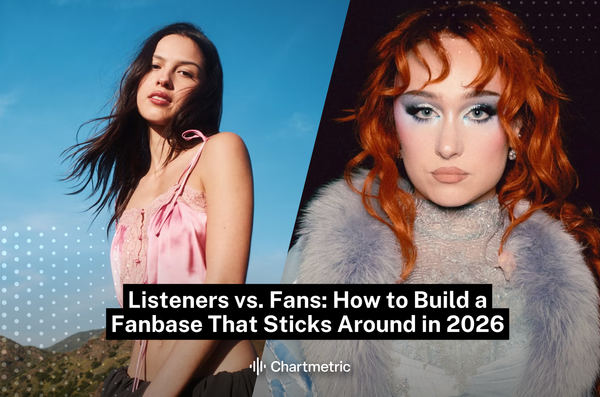

If you’re building a career as an artist in 2026, the path to finding a community of fans that stays invested in your work for the long haul might seem vaguely daunting in the best of moments, and possibly pretty overwhelming in others.
To this end, Chartmetric spoke to two-time Emmy-winning composer, producer and professor Michael Whalen, who has worked with artists like Stephen Sondheim, Fiona Apple, Brian Wilson and Carole King, and also runs a YouTube channel about artist expansion and development. He expressed a lot of sympathy in this department.
“Take a breath and look at what you are expecting yourself to do,” said Whalen. “You’re supposed to write excellent music, record it, produce it, promote it, make videos, understand distribution, answer messages, and keep up with every platform that someone insists is essential. Feeling overwhelmed by that seems like a fairly reasonable response.”
If this strikes a chord, this piece is for you. Alongside Mr. Whalen, we speak to Luisa Houseworks of electronic musician network female:pressure about building fanbases that actually stick around, some artists that have managed to do so, and consider some bite-sized places to start, wherever you are in your career development.
What’s the difference between a listener and a fan?
As many artists who have gone viral on social media have discovered the hard way, your Spotify monthly listener count isn’t exactly a foolproof way to estimate who’s actually going to rock up to your shows.
In his excellent writeup for Digital Music News “The Quiet Death of Playlist Chasing”, Whalen calls Spotify monthly listeners “one of music’s most misunderstood numbers.”
“I think the confusion has grown because we’ve given that number so much authority. People look at an artist’s profile and immediately decide how successful that artist is. You see a big number and think, ‘Wow, something is happening there.’ Something probably is happening, but you need to ask a few more questions to know what it means.”
Even big artists like The Pussycat Dolls, Meghan Trainor, Zayn and Post Malone have struggled with Blue Dot Fever and cancelled tours this year, despite high Spotify monthly listener counts. Let’s compare the numbers for Post Malone and Olivia Rodrigo, two artists with similar streaming statistics, but who had a vastly different 2026 when it came to touring.
While Post Malone’s streams have pulled ahead of Rodrigo’s in September 2026 by several million, Post Malone cancelled six planned US shows and all Asian, Australian and New Zealand dates this year, citing recording an album instead (though most speculate this was likely an excuse for low ticket sales). Meanwhile, with 7 million fewer listeners, Rodrigo has already sold out all 85 tour dates for The Unraveled Tour.
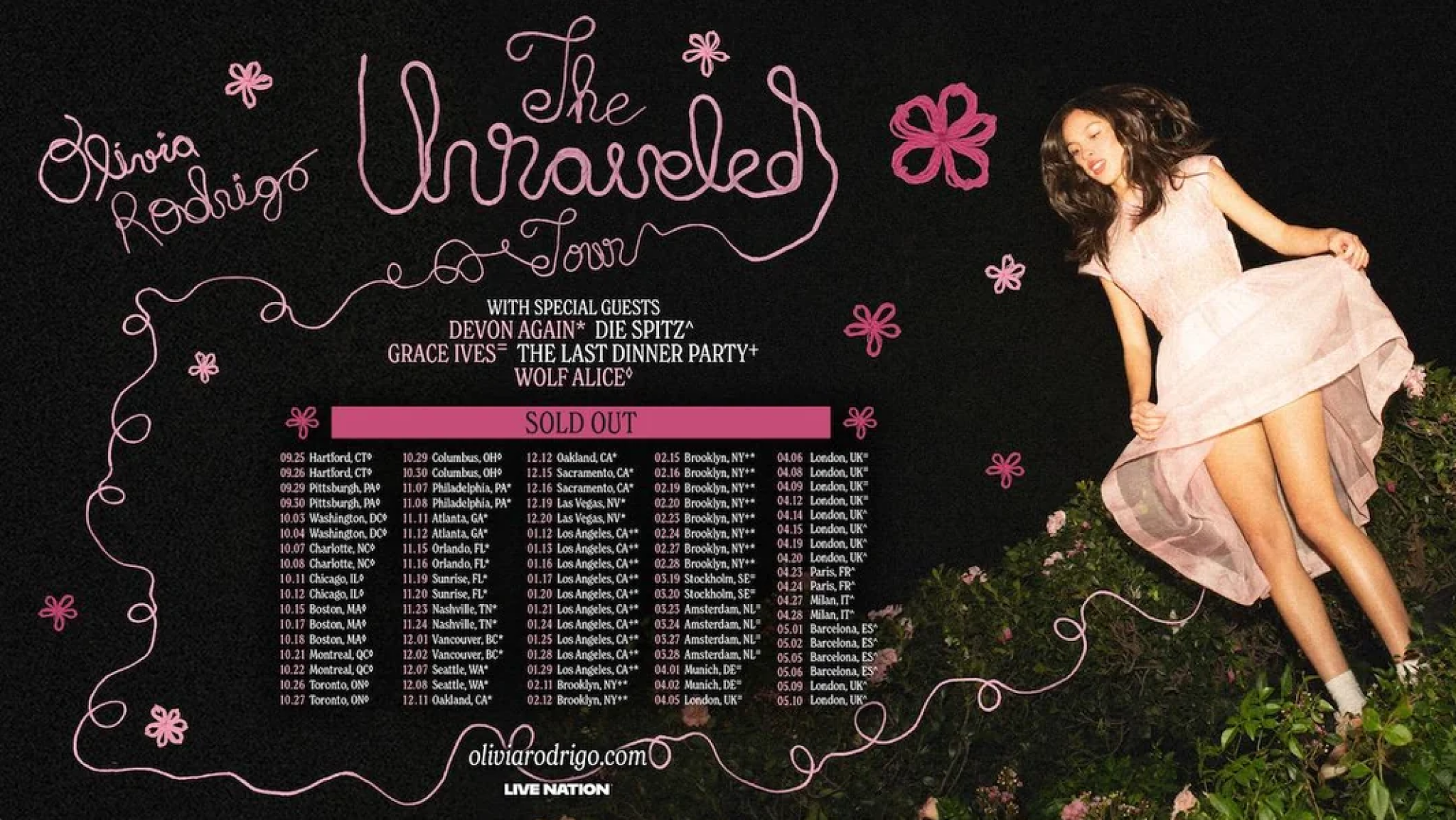
What’s the difference between the average Post Malone listener versus Olivia Rodrigo listener? Rodrigo’s listeners appear to lean towards being more active, meaning they’re taking the next step beyond streaming discovery to become a part of her community, get merch and see her shows.
[Streaming platforms] can deliver exposure brilliantly,” described Whalen for Digital Music News. “What it cannot guarantee is intention. The listener has to decide to take another action, and that next action may be the most important moment in the entire artist-development process.”
Online platforms (both streaming and social media) are the window to discovery, and how fans can find you to take the next step. But when they look through the window, it’s up to you to ask some questions of yourself. How do you want to meet them, what do you want them to find, and how far do you want to get to know them, too?
What kind of interaction do you want to have with your audience?
“You don't have to do everything just because the industry makes you feel like you should,” says Luisa Houseworks, DJ and host of the female:pressure podcast.
“There isn't one formula that works for everybody. Some artists are very active. They share their process, DJ mixes, radio appearances, shows and parts of their everyday creative life. Other artists are more private or disappear for long periods of time, and that’s part of their identity.”
Houseworks gave the example of IDM duo Autechre, who other than a sparse website interact with fans pretty much exclusively in person at live shows: as illustrated by this timeline of their Wikipedia views, which went up in correlation with the amount of shows they were playing in that span.
While Autechre do admittedly benefit from their status as a legacy act that started out in a pre-internet world, that doesn’t mean newer artists can’t exercise similar kinds of autonomy. One benefit of a decentralised internet culture is that it opens up a lot of possibilities, which independent artists are increasingly using to their own preferences.
Independent Irish singer/songwriter Síomha (She-uvah), for example, recently deleted her Spotify and all mainstream social media profiles, opting to focus on Patreon and Bandcamp.
“It’s no longer ‘fuck the system’. The system is fucking itself. It’s not working, and I’m relieved to tell you I’m out,” she said in a recent Substack post. “I took my music off Spotify, and guess what? Life went on. So removing myself from social media seems like the next natural step.”
That said, there’s no one right answer: lots of artists are mixing-and-matching, experimenting with a combination of alternatives alongside legacy platforms. UK-based electronic artist Logic1000 (Samantha Poulter), for example, just released her newest album Confirmation! at the beginning of this month.
In part due to a feature from Christine and the Queens, Poulter’s track “The Only One” has been doing some numbers on TikTok. But it’s what she’s doing in addition that’s laying the groundwork for a core fanbase that keeps coming back to her work, including long-form storytelling through her Substack newsletter Therapy~, a release launch listening party in London — for which she offered a ticket giveaway to her mailing list — and a collab with More Girls Behind Decks, a workshop series introducing girls to DJing.
Houseworks advises that it’s best to make the decision about the level of interaction you want as early as possible, as fans will become accustomed to that style (but that said, don’t be afraid to switch gears if the time comes).
What do you want to build?
A well-established DJ, producer and studio-runner in the local scene of El Paso, TX, Houseworks manages the female:pressure podcast, which hosts the sounds of an international network of female, trans and nonbinary electronic artists.
“Curating the podcast has shown me how important artist-led spaces still are, especially because discovery doesn't have to depend only on an algorithm,” Houseworks told Chartmetric.
Through the female:pressure network, founded in 1998 by Susanna Kirchmayr (artist name: Electric Indigo), members of the network can access each other’s music through its ever-expanding database. Houseworks also keeps a shared folder of music that artists can dig through, with everything from techno, house, experimental and leftfield. Because the network also consists of journalists, independent radio operators and other industry professionals, it creates other ways for the music to spread through media and broadcasting.
“That's probably the biggest thing I’ve learned from curating: building an audience is not always about reaching the largest number of people,” said Houseworks. “It’s not necessarily about becoming viral. The most valuable thing you can do is make it easier for a curious listener to find the next person, continue to participate in your scene, and show up for yourself and the people around you.”
Whether underground or mainstream, artists of all levels have opportunities to make the kinds of choices that override transactional relationships to create avenues of care between artist and listener. Take Midwest Princess Chappell Roan, who over the course of her career has been consistently showing up for the LGBTQ+ community and putting lots of TLC behind the audience experience.
She’s put her money where her mouth is by hiring local drag queen openers, making thoughtful venue choices (e.g. ones that have gender-neutral bathrooms, and security that are aware they will be servicing a young queer crowd), encouraging fans to dress up for show themes, and launching an ongoing initiative supporting LGBTQ+ organizations. Her fans show up, with sold-out stadium shows as high as 30,000 capacity for her Visions of Damsels & Dangerous Other Things Tour in 2025.
“I used to say her fan base was not as wide, but it was very deep,” Kiely Mosiman, Roan’s agent told the New York Times. “Like, if you listen to Chappell Roan, you’re a huge fan of Chappell Roan.”
Who is your audience?
“We spend so much time imagining the audience we would like to have,” described Whalen. “There is real value in getting to know the people who have already arrived. If a few people keep coming back, pay attention to them. That is a relationship you have managed to create through your work, and it deserves care.”
By asking just one person who follows your music a couple of questions, you can discover a lot. How did they find your music? Which tracks are they returning to the most? When do they listen, and what are they most enjoying about the community you’re building?
If you prefer to use social media sparingly, Whalen advises occasionally putting out a short survey or poll with an easy question to reply to. “I would much rather have a useful conversation once a month than train people to ignore me several times a day.”
Alongside getting curious about the people giving time to your projects, you can also let fans get curious about you. Even if you’re going through it, you can share that, as indie pop singer Brye did when her music equipment was stolen out of her van while on tour.
The post landed her over 80% of the tour’s ticket sales, totally eclipsing the 100 tickets she had sold prior, despite having 400,000 TikTok followers. “I got really lucky that, in my misery, I posted a video being like, ‘I haven’t sold any tickets,’ and then that blew up, so everybody was like, ‘Oh, wait, I know you, and I’m gonna go,’” she told Inc.
Beyond sharing the process, Houseworks advises going to the places where people who enjoy the sort of thing you make already are, and making one connection.
That could be a radio show, podcast, record store, small event, collective, online database or another artist’s audience. Send an email, submit a mix, go to a show, buy someone’s music or tell another artist you played their track,” said Houseworks. “A lot of opportunities start with people simply knowing you exist and remembering you.”
In general, the tiniest steps can often take you the furthest distance. If you find yourself getting into a spiral about everything that might happen in your entire career, try just sending one email, Whalen suggests, and keep an open mind about what might be a natural part of progressing, even if not the most obvious.
“The work of figuring out your goals and dreams counts. So does earning a living while you develop. My own experience certainly hasn’t been one narrow path. Different opportunities can support you and teach you things that eventually appear in your music.”