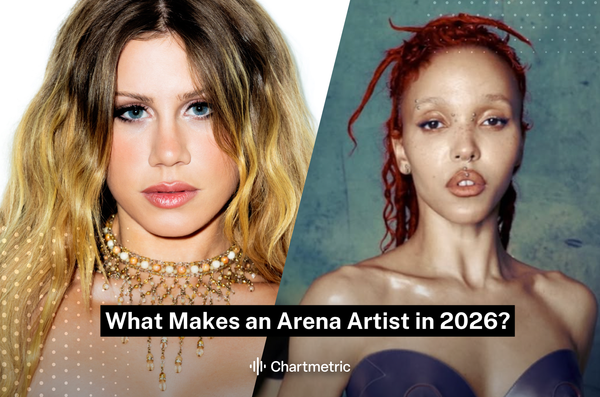

If you had asked a Slayyyter fan in 2025 whether the Missouri pop star would be able to sell out Madison Square Garden, they probably would’ve laughed in your face. That’s no disrespect at all to the artist. At the end of 2025, the pop star played to Webster Hall’s respectable 2,500 capacity. And before that, on her tour in support of 2023’s Starfucker, Slayyyter sold out Brooklyn Steel’s 1,800 cap. But her most recent record, this year’s WOR$T GIRL IN AMERICA, launched her into an entirely new tier of fame. With a companion project along the way, Slayyyter’s ascent does not seem to be slowing down any time soon. In 2027, she will have achieved, perhaps, the single greatest proof of her breakout success: a tour date at the self-described World’s Most Famous Arena, Madison Square Garden. After announcing the tour date, Slayyyter sold out all 20,000 seats in the arena, though she has yet to land a top 20 single or album on the Billboard charts.
It raises an interesting question: how “big” does an artist have to be to play Madison Square Garden? After all, supposedly “niche” pop artists are selling it out more than ever. Earlier this year, FKA twigs sold out her tour date at Madison Square Garden, scaling up from her previously planned show at Queens’ Knockdown Center. Artists like Carly Rae Jepsen and Cleo Sol are slated to play The Garden in 2027. So, what defines an “arena artist” in 2026 anyway? Are there key metrics that might help guide the capacity of the venue an artist can play or sell out?
Perhaps the most important context for what defines an “arena artist” in 2026 is the general increase in demand and ticket sales. Following the COVID pandemic, consumer interest in experiences, especially live events, increased dramatically. According to a New York Times article from 2024, concert attendance “climbed about 18 percent” from 2023 to 2024 as the industry rebounded from the pandemic-related closures. Even as total concert revenue course-corrects from the Eras Tour-fueled highs of 2023, post-pandemic levels of attendance and box office revenue are still up significantly compared to before the pandemic. In 2025, overall concert grosses were 61% higher than 2019, according to the trade publication Pollstar. In the current climate—where general excitement for concerts is still perhaps higher than ever—artists might be capable of playing to larger venues than they would’ve in the prior decade.
In Slayyyter’s case, her ticket sales for the sold-out Madison Square Garden show also likely benefited from certain audience demographics. By all measures, Slayyyter’s engagement metrics suggest a strong audience with significant potential for growth. She has 12 million Spotify followers and 886K Instagram followers as of October 28th, 2026. However, compared to other artists set to debut at Madison Square Garden over the next year, her following does not necessarily suggest the same level of popularity. For example, Sombr is also set to play Madison Square Garden for the first time in November, with 54.7M Spotify monthly listeners and 3.8M Instagram followers, as of October 28th, 2026. Earlier this summer, Rosalia played the Garden for the first time with 26.5M monthly listeners and 27.8M Instagram followers. In fact, when looking at the ranges of Spotify monthly listeners for first-time performers at Madison Square Garden, there is no consistent range, from Two Door Cinema Club’s 9.2 million to Demi Lovato’s 36.9 million.
Instead, a given market’s affinity index might provide more helpful guidance on how an artist might perform in a given city. For example, Slayyyter has a 1.18x streaming affinity in New York City, a metric that estimates how closely an artist performs in a certain city compared to how other similar artists perform. In fact, Slayyyter has 247.5K monthly listeners in New York City, with a higher streaming affinity than other major markets like Los Angeles (0.95x), Chicago (0.92x), London (0.85x), and Sydney (0.84x).
In addition, her New York City fanbase has seen the greatest percent increase in Spotify monthly listeners over the last year. Typical benchmarks for measuring popularity, like Spotify monthly listeners, might not necessarily compare to the Billboard-topping artists. But Slayyyter’s audience is clearly concentrated in New York City, suggesting a Madison Square Garden show would be feasible. With the presale selling out and 200k fans reportedly queuing for tickets, it appears to have been a smart bet on her part.
On the other hand, a pop artist like Rosalía—whose benchmarks of popularity are more traditionally at the “arena-level—” actually underindexes in New York City with an affinity of 0.7x. Part of this is, of course, attributable to language. Rosalía is a Spanish-speaking artist, and therefore overindexes in markets that speak Spanish, like her native Catalonia. That said, higher overall metrics, like 10M Spotify followers and 32.7M followers on TikTok, make playing arenas across the United States a safer choice for her, even if New York City isn’t her primary market.
Another example is London R&B singer Cleo Sol, who recently announced a brief, seven-date arena tour across the United States in 2027 in support of her album Gentlewoman. Part of the strategy here is scarcity. Cleo Sol focuses exclusively on major markets in America—cities like New York, Los Angeles, Chicago, and Atlanta. By scheduling fewer shows in the US, she increases the potential capacity of the venues she does play. Cleo Sol’s overarching metrics do not necessarily point to Madison Square Garden-level capacity: earlier in 2026, she reached a peak of 4.3 million monthly listeners and 1.2M Spotify followers. Undeniably, she has a massive audience. But that is not necessarily the Top 40, Billboard-charting level that arenas typically host.
However, like Slayyyter, Cleo Sol significantly overindexes on affinity for the particular cities she chooses to play. For example, Chicago accounts for an estimated 3.5% of Sol’s overall audience, and she holds a 2.1x affinity for the Windy City. Chicago accounts for even more of Sol’s audience than her native London, which consists of an estimated 2.89% of her audience. Atlanta, another stop on the Gentlewoman Tour, also significantly overindexes, with 1.9x affinity. Playing to the cities where your fans live seems like a straightforward and obvious touring strategy. But Cleo Sol’s shorter tour also allows her to scale up to bigger performances rather than playing mid-sized venues in more cities. An arena artist is not necessarily an artist who defaults to the largest possible venues for every tour.
Take Fontaines DC’s upcoming tour in support of their fifth album, Dopamine Chamber. The alternative band has a clear hometown advantage in Dublin, which accounts for an estimated 9.3% of their total social audience and boasts a 4.8x affinity index. In the U.S., however, their popularity varies by city, with a 0.7x affinity index in New York City and Los Angeles compared to just 0.3x in Nashville and Atlanta.
The band’s tour reflects these differences in demand. In New York, Fontaines DC will play two nights at the 13,000-capacity Forest Hills Stadium, while in Los Angeles, they’ll headline the 18,000-capacity Kia Forum. Of course, population size also matters: a 0.7x affinity index in Los Angeles can justify an arena show, while the same index in a smaller city might not. In Detroit, the band will play the 5,000-seat Fox Theatre, while Boston, which shares New York and LA’s affinity index, will host two shows at the 5,000-capacity MGM Music Hall. By adjusting venue sizes and the number of shows to match local demand, Fontaines DC can operate as an arena act in certain markets while avoiding “Blue Dot Fever,” a term associated with tours struggling with underperforming ticket sales.
Ultimately, the most important determining factor in the definition of “arena artist” in 2026 is engagement, not scale. In a prior era of touring—one where concert tickets were much cheaper—the idea of an “arena artist” was more straightforward. An artist who has massive record sales, chart hits, and media coverage was assumed to have a wider reach. With that wider reach, they could feasibly play to the biggest venues in a given city and reliably fill them. However, ticket prices for the top global tours increased +50% from an average of $91 in 2019 to $136 in 2024, a surge in pricing that’s only expected to grow. For casual fans who may only engage with an artist by hearing their song on the radio or via popular Spotify playlists, their level of familiarity and fandom might not be enough to justify the price of admission to a concert at Madison Square Garden. But for an artist who has cultivated a loyal fanbase, a greater percentage of that fanbase might be willing to pay for a ticket, even if that fanbase is technically smaller than the supposed arena-level one.
Generally, many of the artists who might, on face value, not appear to be arena acts have higher engagement. For example, back to Slayyyter: the star’s fanbase already over-indexes in New York City. In addition, her social media metrics suggest a strong level of engagement, implying more of her fanbase might buy a ticket to see her. On Instagram, Slayyyter’s engagement rate is 15.33%, much higher compared to other artists making their Madison Square Garden debut. Sombr’s Instagram engagement rate is 8.3%, while Rosalía’s is 2.9%. Plus, Slayyyter’s engagement rate continues to increase as her reach expands.
Many of the artists playing arenas without obvious chart hits—like Slayyyter, Fontaines DC, Cleo Sol, and FKA twigs—see similar levels of engagement. Though they don’t have as wide a reach, they make up for it in a deeply engaged fanbase who will show up for their favorite artists. Cleo Sol sees an engagement rate of 15.7% on Instagram and 40.5% on TikTok. Fontaines DC have an engagement rate of 8.5% on Instagram and 17.9% on TikTok, also above their respective medians. On the other hand, artists who have publicly canceled their tours—like The Pussycat Dolls, Meghan Trainor, and Zayn—have noticeably lower engagement rates. The Pussycat Dolls’ Instagram engagement rate is 5.8%, Zayn sits at 3.3%, and Trainor’s is even lower, at 0.2%.
Buying a concert ticket to see an artist is, in fact, the single most important and most accurate metric for understanding an artist’s fanbase. If Fontaines DC can sell out 26,000 seats in two nights in New York City, they are certifiably arena-level where it matters most. Benchmarks like Spotify monthly listeners or Instagram followers only capture one side of the story. In 2026, an “arena artist” cannot be pinned down to a single type. A widely known pop star or a smaller artist with a deeply engaged fanbase can both sell out Madison Square Garden.