
Blue dots can keep artists up at night.
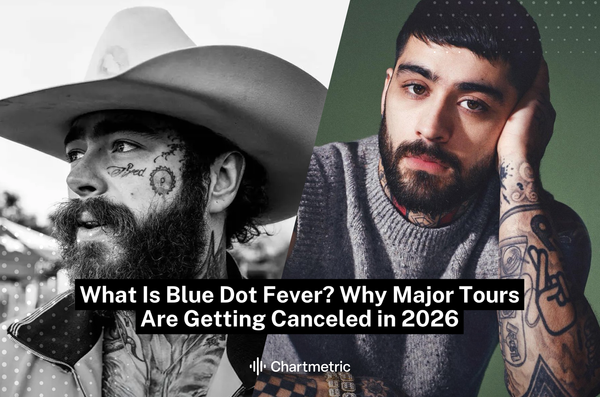
For the last few months, the term “blue dot fever” has spread through the music industry after several headlining acts, including Post Malone, ZAYN, Meghan Trainor, and the Pussycat Dolls, canceled all or part of major tours. The blue dots in question are the available seats on a ticketing page, and apparently, these tours were riddled with them. IE, their tours did not sell enough tickets to make a profit.
Of course, the real story may be more complicated than any single explanation. None of the artists admitted that ticket sales were the reason for the cancellation. Doing so would only double down on the harm to their reputation that comes when axing a tour. Post Malone, real name Austin Post, said he needed to finish a new album. Trainor cited her new baby.
However, three factors surrounding these tours suggest ticket sales could be the culprit.
First, ticket prices are soaring. With many people struggling with the cost of living, the idea of spending money on a concert is becoming less realistic for fans across the board. Second, the above artists share several prominent discrepancies in the data that could suggest they have fewer dedicated fans than it may seem. And finally, the sheer volume of tours competing for fans' attention and dollars right now may be diluting demand for any single show
The Spotify monthly listeners of the artists above suggest a huge amount of fandom. They range from 16.5 million to 60.6 million, with the Pussycat Dolls and Post holding the lowest and highest positions. Post regularly sits well within the top 50 on the entire platform.
The issue lies in how Spotify calculates monthly listeners. Whether someone is playing Post’s latest album, F-1 Trillion: Long Bed (2024), on repeat or simply letting “Sunflower” (2019) pass as part of a workout playlist, they would both count as one monthly listener. And only one of them would likely spend the minimum $57 (plus drinks, transportation, etc) to see him perform at a stadium.
So, in looking at where these artists are getting their listeners on Spotify, all of them are seeing the majority go to songs they released in a previous era. Scanning Post’s daily change in Spotify streams over the past year, famous songs such as “rockstar” (2017), “Circles” (2019), and “Congratulations” (2016) consistently receive the highest numbers compared to newer songs in his recent live setlists, which can be found on Setlist.FM.
The most conspicuous example is ZAYN, real name Zayn Malik. He has almost 26 million monthly listeners, but three songs are dominant in total streams: “PILLOWTALK” with 1.8 billion, his Taylor Swift collaboration “I Don’t Wanna Live Forever,” with 2.2 billion, and his Sia collaboration “Dusk Till Dawn,” with 2.3 billion.
All three of these songs were released between 2016 and 2018, and the only one he’s performing lately is “PILLOWTALK.” Then, his daily change in Spotify streams shows that these three songs get at least 600k more plays every day than the next most popular song, which usually gets around 50k.
These stats then create a feedback loop into playlisting data. ZAYN’s top three songs are in almost 10 times as many playlists as the rest of his catalog. None of Post’s top ten songs in terms of playlist adds are from this decade. If certain songs are always getting the most plays, the algorithm will put them in more playlists while leaving newer songs behind. As such, if the vast majority of people listening to the music only care about a certain few old songs, why would they want to spend their money on a concert?
This puts artists in a serious conundrum. Touring is how they earn the bulk of their income, and most people listen on streaming. So, if streaming is leading to fair-weather fans by nature, artists may have to reconsider their approach to touring.
They could accommodate smaller spaces to perhaps bank on exclusivity to maintain their illustrious reputation. Another option is doubling down on fan engagement to get more people in their camp.
Luminate just released a study stating that Gen Z audiences are willing to spend their money despite the rising costs. Many in that generation were too young for these artists' most popular songs, but if the artists can find a way to get more of them interested, their touring careers can be healthy long into the future.
This prospect goes beyond the music. As the Pussycat Dolls demonstrated, collaborating with a currently popular artist doesn’t necessarily do the trick. They tapped Sara Landry, one of the most popular DJs in the world at the moment, to remix their new single, “Club Songs,” and it doesn’t even have 180k streams yet.
Luminate’s findings back up a study by Live Nation that found that Gen Z places great emphasis on in-person events, and artists are already addressing this dynamic. For example, artists of all genres and levels of fame are hosting pop-up sets in unconventional locations to provide fans with more intimate, memorable shows. Other artists are investing in intricate activations.
Olivia Rodrigo curated two simultaneously running immersive activations in Los Angeles ahead of her third album, you seem pretty sad for a girl so in love (2026). Moreover, she also personally hosted a listening event. Now her entire world tour and her new festival, Daisy Chain Fields, are sold out.
@nadjab3lla still can’t believe she surprised us :,) LA livies u musttt come to the cure gallery!! @livies hq 🩷 @Olivia Rodrigo #oliviarodrigo #yspsfagsil #or3 #thecure #losangeles @Grace Sofia
♬ original sound - ☆ ౨ৎ ☆
When mainstage DJ/producer Kaskade hosted a pop-up merch shop for his latest album, undux (2025), he personally greeted fans at the door. For Elise Milani, Director of Operations & Marketing at BLK Matter Ltd and part of Kaskade's management team, the lesson is simple:
“How are you making those people feel like they're valued?”
Rodrigo and Raddon certainly made their fans feel valued by showing up to these events themselves, but artists constantly doing in-person events is unrealistic, so this is where Milani defers to the data.
Prior to BLK Matter, Milani worked at 2plus2 Management with the alternative electronic artist REZZ, real name Isabelle Rezazadeh. Rezazadeh has an exceptionally dedicated fanbase, to the point that they willingly branded themselves as “the cult.” In strategizing how to build a community around Rezazadeh, Milani wasn’t looking at numbers like monthly listeners. Instead, she would dive into ticket buyers, often seeing that as many as half of them traveled from out of state to see Rezazadeh perform.
“What are they doing while they're there? Is there more that can be built around that?” Milani asks. She would often design custom merch or host temporary pop-ups in the area. “It lent to a lot of culture being created by the community itself. We were helping fuel it by giving them opportunities to meet.”
“When I saw [Rezazadeh’s] cult exponentially growing, I was just like, ‘Man, this is so valuable,’” Milani says. “Those superfans that feel a sense of belonging because of you, they're not just buying from you. They're advocating for you.” But such fandom can also be a delicate thing, especially these days with the cost of living being where it is. Immediately jumping on a larger space could suddenly price out the younger fans that supported an artist’s rise in the first place.
“People can lose interest after a certain point if they don't feel like they belong anymore,” Milani says.
Blue dot fever proves that deciding which rooms to play throughout a career is never set in stone. Agents have to look at various sets of numbers every time they’re deciding how to route a tour. For booking coordinator Julian Schwartzman of Liaison Artists, routing a tour means looking far beyond Spotify monthly listeners. Past ticket sales, gross history, and other indicators of fan demand ultimately determine which rooms an artist can realistically fill.
“If they've sold out, how much can I potentially push those costs up to where our fans will still want to buy with all of the fees that potentially come on top of the tickets?” Schwartzman asks. Every production upgrade, from a larger band to more elaborate staging, eventually affects ticket prices, making tour scaling a balance between the artist’s vision and what fans can realistically afford.
One forward-facing metric Schwartzman has noticed suggests more leeway with budgeting is Instagram. Artists who present an exciting show through video content pique the interest of potential fans regardless of their music. He specifically points out Baby J, a DJ who doesn’t produce original music, but she has nearly 800k followers on Instagram. Now she’s performing at Coachella’s Do LaB stage and helming Asia tours.
Social media seems like it wouldn’t be an issue for the blue dot fever artists, as many of them have tens of millions of followers. But Post, Malik, and Trainor have all seen a net decrease in Instagram followers over the last two years.
“Great [music] only gets you so far, which is so unfortunate, because there's so much talent out there,” Schwartzman says. “Having a strong social media presence in today's music industry goes a very long way in terms of being able to move tickets, because you're getting that visibility. They see it via social media, and they say, ‘Wow, $20 for me to experience that? I wanna go.’”
And yet sometimes, even if the artist does everything “right,” prices tickets fairly, routes the tour well, plays realistic rooms, longstanding fans still might not want to go anymore because of this thing called life. A lot can change in a few years. Post’s most popular songs are from seven years ago. Fans can have children in that amount of time, and suddenly concerts just aren’t a priority anymore.
Milani presents it as a form of empathy: “You have to think, what are their hopes and aspirations? What are their pain points? What's holding them back? What are they thinking about when they're considering buying this ticket?”
The younger generation is thinking about concerts. It may be daunting for established artists to work towards attracting a new community when their previous armies were so loyal, but getting fresh faces on board is the surefire way for those blue dots to become fans in the seats.