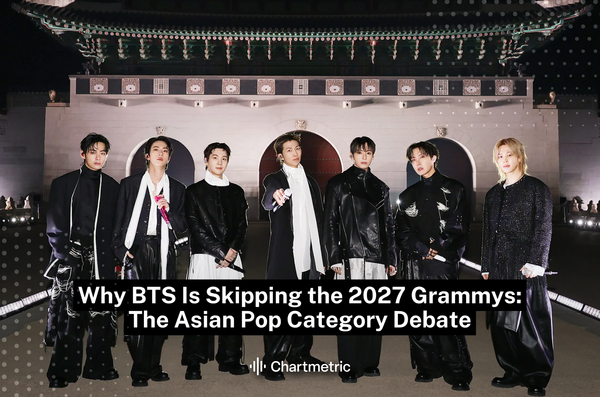

Earlier this year, BTS made headlines by announcing they would not submit their music to the 2027 Grammys for consideration. Having just dropped ARIRANG (2026), their first LP in four years (and the first after their hiatus due to mandatory military service in South Korea), the massive K-pop boy band was a shoo-in for an Album of the Year nomination.
However, they decided to sit out “Music’s Biggest Night” due to the introduction of the new Best Asian Pop Music Performance category. All seven members put out the following statement in response:
“We hope our music can be heard and loved for what it is, rather than being divided by region or language.”
Harvey Mason Jr., CEO of the Recording Academy, the non-profit that runs the Grammys, then released a statement following BTS’s announcement:
“I do want to clarify something that seems to be getting lost in the conversation. The Asian Pop category was created to celebrate the depth, diversity, and extraordinary growth of pop artistry coming out of Asia. More categories mean more artists’ work is recognized. It’s never to divide, but to expand who is recognized by our 15,000 Grammy voters.”
After that, there were discussions about removing the category, but Mason Jr. later released another statement that the award would remain in the ceremony.
He is certainly correct about the “extraordinary growth” of musicians originating from the Asian continent. BTS just broke the record for revenue from a single tour, earning $465.8 million with their run in support of ARIRANG.
Another example is the Netflix film K-pop Demon Hunters, which holds the record for the most-watched original Netflix title with 325.1 million views. The movie also produced the #1 hit “Golden,” which currently has 1.9 billion Spotify streams. Furthermore, all three singers representing the fictional band in the movie, HUNTR/X, are Asian or Asian-American.
Data backs up the growth as well. Throughout Chartmetric’s history, the saves for K-Pop ON! (온), Spotify’s most popular K-pop playlist, have gone up by 1,700% from 348k to 6.1 million. That increase stems from only 37.8k artists and 351.6k songs labeled as “K-pop” on the Chartmetric platform. Plus, the playlist features far more artists than BTS, BLACKPINK, and others that have reached international superstardom.
Anime Now, the most popular J-pop playlist on Spotify, began its history on Chartmetric with 26.2k saves. It now has 1.5 million, a 5700% increase, with 55.3k artists and 434.9k songs.
Comparatively, within Chartmetric, Rap Caviar is the biggest playlist on Spotify for three mainstay genres: hip-hop, alternative, and electronic. With over 5 million artists and 40 million songs across those three styles, Rap Caviar has increased from 5.8 million followers to 15.7 million in the same period. That’s less than a 300% increase. So, while the total number is higher for Rap Caviar, the ratio is astronomically higher for the K-pop and J-pop playlists.
Simply put, listeners are flocking to sounds from Asia, and the Asian Pop category is not the first time the Grammys have introduced a category in response to growing regional popularity. The Best African Music Performance category was added in 2024 following the similarly extraordinary growth of artists such as Burna Boy and Wizkid, who are currently sitting at 46.2 million and 15.8 million monthly listeners, respectively.
Hong Kong-born artist and songwriter XTIE is thrilled that her fellow Asian artists are seeing this same kind of global success, but the rub lies in the fact that she can’t submit her music to the Asian Pop category because she sings in English. It doesn’t matter that she built her song “Star Potential” from Cantonese folk melodies. According to the description for the category:
“Recordings performed entirely in English are not eligible in this Category and remain eligible in other appropriate Categories.”
Moreover, XTIE was also sidelined from the most popular awards show in Hong Kong—when translated from Cantonese, the ceremony is called “The Ultimate Song Chart Awards Presentation.” English-language music is not mainstream in Hong Kong, so all the biggest awards go to Cantonese music.
As a native of Hong Kong, a special administrative region of the People's Republic of China, XTIE grew up speaking both English and Cantonese. But English is the language of her musical identity.
“It's not because I have a choice. It's just my natural artistic expression, and I don't want to change that. If I wanted to do so, I would have done it in Hong Kong,” XTIE says, having just recently relocated to Los Angeles. “If I want to release a song in Cantonese, it means that I’d have to find another lyricist to write Cantonese on top of my own melody, which is already originally written in English. That's why I needed to move here.”
And yet despite all these roadblocks, XTIE still wants to win a Grammy, so this year she is submitting for the Best Dance Pop Recording award.
“I feel like it's just a matter of time before I can get a Grammy, and I'm not scared to say that. I want a Grammy,” XTIE says.
She is certainly not alone in that desire. Santiago Restrepo, Head of Latin America (LATAM) at ROSTR, has also managed artists from his native Colombia. His clients frequently told him that they wanted to win a Grammy.
Like Hong Kong, Colombia has its own national music awards show. So do the UK, Australia, Canada, Finland, Japan, South Korea, and plenty of other countries. To a certain degree, the Grammys are just that for the United States music industry. It just so happens the US is the largest recorded music market in the world.
When international artists look to the US, they see globally recognized entities such as Coachella, the Super Bowl Halftime Show, and all three major labels. So it makes sense that they want to find a way into the US market. Not just for the potential prestige, but for the chance to earn a comfortable living as a musician.
With that attention, artists from around the world, like XTIE, have been traveling to the US for decades and bringing their native styles with them. As a result, the Grammys have taken on the de facto role of representing musical excellence around the world. Not just in the US.
The UK is the third-largest recorded music market, but the top honor in the BRIT Awards (the UK version of the Grammys) honors the best album by a British artist. Whereas Bad Bunny, who is proudly Puerto Rican, won Album of the Year at the 2026 Grammys. His appeal is global. Not regional.
“His audience isn't specific. The territory isn't specific. The consumption of that music isn’t specific. So that's why you should give it a shout-out, globally speaking. Artists should get to that point where they could compete globally, because we're talking about Grammys,” Restrepo says. “If you want just to compete locally, you should aspire to win the local award and not the international award. You shouldn't be asking for a Grammy if you're not playing worldwide, and if you're not renowned worldwide.”
To that point, K-pop acts have reached global recognition. BTS performed during the halftime show for the World Cup Finals. But the above data shows other pop-adjacent styles from Asia have global reach, and so the Grammys decided to introduce one award to address them all.
At this point in the process, any sort of decision like this from a prestigious entity becomes political and nuanced. XTIE admits that the biggest style coming from Asia is K-pop. But the idea of introducing just a K-pop Grammy could easily incur similar protests from Asian artists making different styles and hailing from different regions. As Mason Jr. proposed in his first statement responding to BTS, raising awareness was a core drive behind the decision, and Restrepo agrees.
“The Grammys are just responding to how the market works. They're aiming at some recognition for that part of the world that came up with K-pop,” Restrepo says. “They don't want to segregate. It's just like, ‘Hey, let's take a look at this part of the world. Hey, labels, go to Korea and take a look at what's happening.’ The Grammys are an exposure for the business as well.”
Coming from the region, XTIE asks, is Asian pop a genre or geography? The term “pop” is inherently fluid, and so, what makes a version of pop inherently Asian when it is such a massive continent? To the point about languages, Thai is vastly different than Mandarin Chinese, which is vastly different from Indonesian.
“If your award says the song has to be in a majority Asian language, who are the judges? I speak Cantonese and English. Can I judge a K-pop song?” XTIE poses. “It's not like dance pop. Dance pop is a genre. It doesn’t represent a geographical location.”
The clearest example of how region has influenced the Grammys is the Latin Grammys, the only separate ceremony that still holds the Grammy name. Comparable to the Asian Pop category, the Latin Grammys honor music that is sung in Spanish and Portuguese.
Then to that point, an LA Times article published just ahead of the first Latin Grammys ceremony in 2000 said that “the Latin music universe is too large to fit into seven categories,” referring to the seven Latin categories the main Grammys had before the Latin Grammys. After all, there are numerous regional genre categories within the Latin Grammys: Merengue, Cumbia, Tejano, Mariachi, etc.
Whether the Asian music universe has reached the point where it should have its own Grammys is an important discussion to have. After all, numerous genres are emerging: K-pop, J-pop, and C-pop for starters. But the theoretical Asian Grammys would naturally be in a similar class of award as the Latin Grammys, which Restrepo describes as “in a lesser position.”
“It's not the Grammy, it's the Latin Grammy,” Restrepo says. “I think it works perfectly, because if you're working in LATAM, you deserve an award from their territory, not an international award, because you haven't reached that [yet].”
In Mason Jr.’s statement about keeping the Asian Pop category in the ceremony, he discusses conversations he and the Academy had with “leaders of the Asian music community.”
“We heard candid feedback from people in our community who don’t support the continuation of this category. We also heard from people who didn’t have accurate information about the category, and having space to clear up misperceptions has been especially valuable,” Mason Jr. says. “But by far, the loudest feedback we heard was from people who were enthusiastic supporters of the category, fellow music creators expressing their encouragement for keeping it.”
The simple truth is, artists around the world want to win a Grammy, and this award does open a door for more artists to do that. That possibility then encourages more artists to pursue their dreams.