
Depending on who you ask, the success or failure of an album can be completely determined by the first twenty four hours of its release. In hypercompetitive stan Twitter circles, first-day streams for a single or an album are often used as the sole benchmark for success. These accounts meticulously track Spotify streams within the first day of release, and chart devotees declare something a “flop” or not based on this initial demand.
But the truth is, this method of evaluating the quote-unquote “success” of an album or song is outdated in the streaming era. In 2026, any song can become a hit at any time: a Kate Bush single from 1985, a Katy Perry fan favorite from sixteen years ago, or a contemporary country music classic. Measuring success by the initial demand for a single or album is a reductive way to understand the contemporary musical landscape.
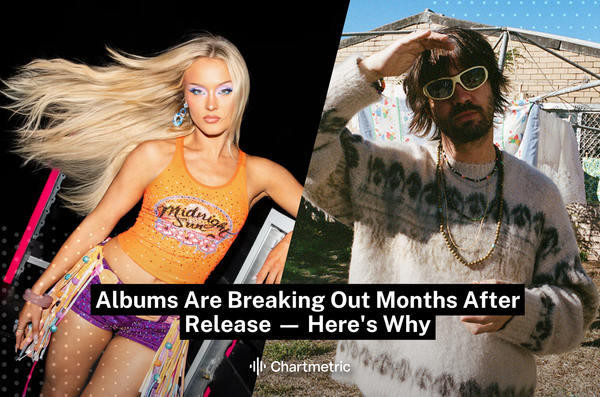
It’s better to play the long game, and artists and labels now know it. Rather than focusing all their promotional spend on the lead-up, some album campaigns have found tremendous success by extending the promo cycle months and even years after the music drops. Multiple albums from 2025—like Zara Larsson’s Midnight Sun, Tame Impala’s Deadbeat—are now having banner years in 2026, scoring chart achievements months after they came out. These albums didn't splash immediately upon release with first-day streams that would impress the Twitter stans. Instead, the music found its fans over time, circulating through TikTok and supported by key syncs in films.
Take Zara Larsson’s fifth album Midnight Sun. On September 3rd, 2026, “Midnight Sun,” the second single from the record, reached a new peak of #59 on Spotify’s Global Chart with 1.746 million daily streams. The song reached this peak over fourteen months after it first came out in September 2025. Upon release, the full album charted at #119 on the Billboard 200. But in May of 2026, Midnight Sun climbed to its new peak of #36, nearly eight months after release.
The album was supported by multiple songs that all seemed to gain traction at once, particularly on TikTok. TikTok Sound Views for “Midnight Sun” and the nine year-old track “Lush Life” were mostly stagnant when “Midnight Sun” was first released in June 2025. But in March of 2026, “Lush Life” began to go viral on TikTok. Sound Views skyrocketed, crossing 6 billion sound views by May 2026. The track’s resurgence, nearly a decade after it first came out, drove traction to Larsson’s other singles. TikTok sound views for “Midnight Sun” began to steadily grow in late February and March 2026. At the same time, Larsson released her remix of PinkPantheress’s track “Stateside,” which reached nearly a billion sound views on TikTok within a month of release. Clearly, all three tracks seemed to drive traction towards each other.
It wasn’t just Larsson’s hits that benefited from all this attention on TikTok. Cuts off Midnight Sun—like the clubby “Hot & Sexy,” “Puss Puss,” and “Eurosummer—” saw spikes in daily streaming throughout February and March of 2026. Midnight Summer’s lead single “Pretty Ugly” had its best-ever day of streaming on Spotify upon release. However, the song saw its second-best daily Spotify streams 162 days after release, with 387.08k streams.
Now, as she tours Midnight Sun over a year after it first came out, Zara Larsson is seeing the residuals of her long album cycle. She continued to engage fans and potential audience members with remixes, guest appearances, and juicy press clips, months after the record first dropped. This year, Larsson’s Spotify monthly listeners reached a peak of 70.01M in May 2026, an increase of over 40 million from when Midnight Sun came out. I’d suspect for her next release, those Day One streams will demonstrate the effectiveness of this campaign.
Tame Impala’s fifth album Deadbeat has seen a similar trajectory. Upon release, the album was met with tepid reactions from music critics, and the lead single “End of Summer” saw much smaller playlisting on Spotify than other similar Tame Impala tracks, like “Borderline” or “Let It Happen.”
Prior to the release of Deadbeat, Kevin Parker’s beloved project had 35.1M monthly listeners on Spotify as of October 13th, 2025. In the weeks following the album’s release, his Spotify listenership grew slightly, up to 43.07M as of November 11th, 2025. That’s a notable growth for the psychedelic pop star, especially following the release of his hotly-anticipated first album in six years. But Tame Impala saw even more substantial growth in key metrics in the year following Deadbeat. As of September 22nd, 2026, his listenership grew to 62.7M , almost doubling his Spotify Monthly Listeners in twelve months. Clearly, it took time for the music to resonate with audiences.
Rather than generating hype before the album came out, Tame Impala benefited from directing fans and new listeners towards the record after it was already released. One such success story is “Dracula.” The song was Deadbeat’s third single. One week after release in September 2025, “Dracula” received 4.7M streams on Spotify, comparable to the 5.44M “End of Summer” received in its first week. However, thanks to a remix with BLACKPINK’s JENNIE, audiences returned to the song en masse. By the end of March 2026, Tame Impala hit 51.1M monthly listeners, a significant spike compared to the 40M following Deadbeat’s initial drop. Following the release of the JENNIE remix, Tame Impala saw the greatest average weekly increase in his social media following, up 103.9K followers on Instagram the week of February 11th, 2026.
“Dracula” wasn’t the only hit to emerge from Deadbeat. “Loser,” the album’s second single, exploded after the song appeared in Spider-Man: Brand New Day in the summer of 2026. After its release in September 2025, “Loser” saw steady growth, reaching 100.6M streams on Spotify by August 4th, 2026, nearly a year after release. However, after Spider-Man: Brand New Day hit theaters, the song’s popularity skyrocketed, growing to 268.9M streams by September 22nd, a growth of over 150M streams in a month.
Views of the song on TikTok grew from 106.6M at the start of August 2026 to over a billion by mid-September. Unsurprisingly, the success of “Dracula” and “Loser” lifted the popularity of the entire album. The Spotify Popularity Index for Deadbeat grew from 78 in March 2026 to an all-time peak of 89 in September 2026, nearly a year after the music came out.
It’s not only established artists like Tame Impala and Zara Larsson who found success in the long album rollout. Pop newcomer Audrey Hobert continued to promote her debut album Who’s the Clown? in an extensive post-release campaign including an NPR Tiny Desk, a filmed performance at the Cherry Lane Theatre, and a performance on Jimmy Fallon.
Hobert’s debut record came out in August 2025. For the first nine months after its release, her Spotify monthly listenership stabilized between 1.5M and 2.3M as the record generated interest among pop music fans and online music circles. Her following on social media saw steady growth during this interval; her Instagram followers grew from 214.6K on August 22nd, 2025 to 349.6K as of May 2026. But due to a steady drumbeat of promo, Who’s the Clown? is only just starting to generate new traction. The album charted on the Billboard 200 for the first time at #136 following the one-year anniversary of its release.
Hobert allowed the music on Who’s the Clown? to find a stable community of fans. By the time she kicked the promotion into high gear in 2026, there was already excitement built in. Hobert’s monthly listeners began to surge in May 2026, increasing from 1.3M on May 12th to 8.4M by mid-August 2026 thanks to her extensive tour, press interviews, and viral performances.
Counterintuitive to the traditional logic of the music industry, the post-album promotion might be more important than the rollout. Generating hype and excitement for release week is a great kickstart to an album campaign, but driving listeners towards a record once it’s already out is increasingly a more strategic path to breaking through in the crowded streaming environment. Midnight Sun, Deadbeat, and Who’s the Clown? all connected with fans upon release. But by building on the fan excitement after their releases, the albums scaled up to even bigger audiences. Stan Twitter might still rely on first-day streams as a barometer of certain artists’ success. But an album’s growth in the year after its release is an even better indicator of longevity.