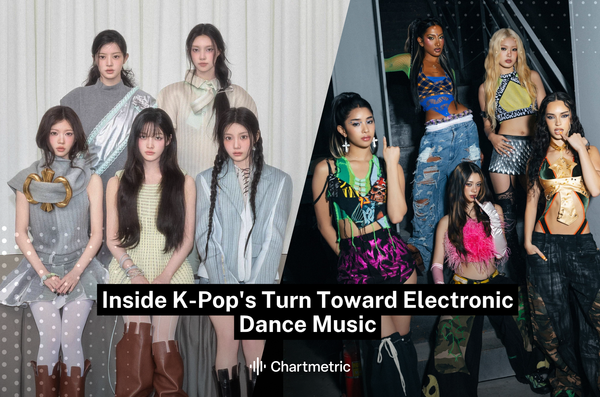

As KATSEYE’s arena-rave world tour storms its way across America, having already hit the UK and Europe, a bubbling trend has reached boiling point: the K-pop universe – once synonymous with trap beats and cute-coded production – has entered its hard dance era.
This was certainly evident at The 02 in London on September 4th when the global K-pop-inspired girl group unleashed techno beats onto an extremely young fanbase who will likely not have experienced such intense sounds before, especially in a live setting.
Despite being two members down for health reasons, the show went on as Daniela, Lara, Megan, and Yoonchae performed in support of their recently released EP. A hedonistic rendition of ‘PINKY UP’, the most-played track from ‘WILD’ with 235.7M Spotify streams as of late September, followed a ravey reimagining of their viral hit ‘Gnarly’. The latter closed the show, capping a performance that was far from your average K-pop concert.
KATSEYE aren’t the only act in the scene who have recently been raising the tempo, however. LE SSERAFIM’s ‘CELEBRATION’, BLACKPINK’s ‘JUMP’, ILLIT’s ‘It’s Me’ and IVE’s ‘BANG BANG’ have all swapped the genre’s trademark EDM production for something closer to Berghain-primed hardstyle.
It’s something that publicist David Lim, who works with LE SSERAFIM and aespa at The Outside Organisation (UK), has watched evolve. “K-pop has always gone hand-in-hand with dance, especially as it is a heavily performance-driven genre, but we’ve arguably reached a saturation point,” he suggests. “K-pop is beginning to gravitate towards a different flavour of dance music, something grittier and glitchier rather than cold, expansive and industrial.” Expanding on this point, he says that “harder beats and more aggressive rhythm framings allow the performers to show off sharper, high-intensity choreography, which, for a visual-based genre like K-pop, is pretty important”.
@le_sserafim 𝗪𝗲 𝗴𝗼𝘁𝘁𝗮 𝗿𝘂𝗻 𝗮𝗴𝗮𝗶𝗻 🪐 #CELEBRATION
♬ CELEBRATION - LE SSERAFIM
While Lim argues that “we’ve seen almost every kind of electronic dance music style – including house, UK garage, dubstep and bounce – flow in and out of popularity over the past few decades”, there are several reasons why more intense sounds have infiltrated the K-pop scene. Lim argues that part of this slam towards hard dance in the past two years could be linked to the surging global popularity of harder styles in the mainstream. “On one level, the impact could be traceable to Charli xcx’s ‘Brat’ and peers like Shygirl and PinkPantheress,” he suggests, citing 2024 as the turning point.
“Alongside the global ‘Brat’ movement, aespa shook K-pop with a double whammy of their bangers ‘Supernova’ and ‘Whiplash’, moving between hyperpop and dark industrial house and techno beats with a crisp delivery, while LE SSERAFIM delivered the house and bounce-injected ‘Crazy’.” By this point, Lim recalls, “the BPMs had started rising”.
He also believes the increasing number of K-pop artists touring internationally post-pandemic is a major factor fuelling the trend. “We can’t underestimate the importance of having a rocket-fuelled dance banger in the setlist to create these euphoric, crowd-jumping moments for fans looking for an escape,” Lim says, pinpointing both festival slots and stadium dates.
While he recognises that “it’s obviously not suited to every K-pop artist and their audience, for those with a younger audience these harder styles of dance music give fans the sugar rush and cathartic release they need at a live show”. He adds that, on a base level, it is “really fun and interesting to think about a younger audience having these tracks as their gateway into techno and rave music”. He goes on to draw a connection with people’s shorter attention spans: “a harder and faster BPM catches your attention quickly while you’re scrolling!”
The recent pivot within this sector of the music industry is incredibly well timed considering the future viability of K-pop came into question in a Guardian article published in March 2025. Though an unplanned retort, ‘It’s Me’ by ILLIT was released just four days later and has since clocked up 162M streams on Spotify—this is more than 10 times other tracks on the ‘MAMIHLAPINATAPAI’ EP that it is taken from.
‘PINKY UP’ is, however, the clearest example of changing tastes: an injection of adrenaline-filled energy, there’s no denying that it provided a decidedly underground jolt for fans perhaps bored with K-pop’s often homogenous pop sound. Alongside clocking a huge 1.88BN TikTok views as of late September, the track has become a major talking point.
In fact, it divided music critics, including THE FADER, who published an entire feature where two journalists sparred about whether ‘PINKY UP’ is a hard-techno gag or ‘a sorry victim of the TikTokification of music’. India Roby argued that “it continues the trajectory of what has become synonymous with the group’s image: subversive brainrot that’s been cranked to the max”.
Tobias Hess, contrastingly, argued that since it arrived after BLACKPINK’s ‘JUMP’, “a song that also went diet Berghain, KATSEYE’s pivot to the club feels less jarring. Especially given the group’s penchant for unseriousness, I think the genre suits them well”. Reaching a sort of conclusion, he said “the musical headline here is not the vocals or the lyrics, but the production, namely the chorus’s hard techno brutalism”.
The Bias List, a blog for K-pop reviews and discussion, also recognised the trend within LE SSERAFIM’s ‘CELEBRATION’, which has a hardstyle/gabber moment near the close. They said: “all of a sudden, it feels like a certain type of EDM – oontz oontz techno beats and attitude-heavy sing-talk – has taken over K-pop — or at the very least taken over HYBE Corporation. This isn’t an unwelcome development in my eyes (anything to kick up the industry’s tempo a bit!)”
With masked club icon horsegiirL having brought BLACKPINK’s JENNIE out at a Lollapallooza Chicago after-party in August, and hard techno priestess Sara Landry having remixed the aforementioned ‘CELEBRATION’ in May, 2026 has become the crossover moment for the two previously disparate genres. As of Oct. 7th, Landry’s edit has had 1.4M TikTok views and 536.1K Spotify streams.
Lim predicts that this hybrid of styles will continue to widen fanbases on both sides of the sonic spectrum: “It’s about time we had more electronic music artists and DJs team up with K-pop idols,” he says. “Fans can smell a corporate collab from a mile off, so as long as the collaboration feels authentic to the artists involved, it can only benefit everyone by expanding their audiences.”
While it remains to be seen whether the harder dance K-pop tracks will climb the charts and find greater success on a global level, Lim believes there are benefits to be found elsewhere. “Dance music belongs to the people,” he concludes. “The real hook here is seeing the kind of doors it might open for them on the global dance music stage.”