
Some of the most iconic moments in music history are also acts of activism. Jimi Hendrix played his untamed rendition of “The Star-Spangled Banner” at Woodstock during the height of the Vietnam War. Queen’s Live Aid performance is often credited as the best rock show ever.
Today, artists don’t have to do anything so iconic to stand up for their beliefs. All it takes is the click of a button on social media to broadcast their thoughts and opinions to millions of people. Although, as with anything so convenient, there are drawbacks. As easily as artists can support causes they care about, they can just as easily be berated by people who disagree with them.
Moreover, just the fact that social media exists puts immense pressure on artists to be involved. Benign posts are often flooded with comments along the lines of “Why haven’t you said something about X issue?”
Within this dynamic, many artists feel obligated to speak their minds. After all, incredibly few individuals have so many people invested in their words:
“Music is how we heal things, but silence can speak too,” wrote the alternative electronic artist TOKiMONSTA in an Instagram post announcing she would remove her streaming catalog from Israel due to the ongoing conflict between Israel and Palestine.
On the other hand, for many artists, music is meant to create relief from such issues. As James Hetfield of Metallica recently said:
“Metallica is not here, like some other entertainers, to influence you with their bullshit. We are here to forget about all the outside shit. Metallica's agenda is love, energy, and heavy music, baby!"
Wherever an artist falls on the spectrum between obligation and relief, seasoned pop culture journalist Rachel Brodsky notes the salient point all artists have to consider:
“Inevitably they will be asked,” Brodsky says. “They should be prepared to say how they feel about global and domestic issues.”
Throughout her career, Brodsky has interviewed some of the biggest celebrities on the planet, including Dua Lipa and Paris Hilton. She also just published her debut book, Lessons & Lace, on 1970s rock star Stevie Nicks. With that broad knowledge of music history, she points to how the culture around artist activism has changed since social media arrived.
“Taylor Swift has spoken about how she was told by her label to always keep quiet and not ruffle any feathers in the political sense,” Brodsky says, going on to cite the Chicks (formerly the Dixie Chicks) as an example of the worst-case scenario in that regard.
In 2003, shortly before Taylor Swift came on the scene, Natalie Maines, lead singer of the Chicks, spoke out against then President George W. Bush and the Iraq War at a concert in London, stating:
“We do not want this war, this violence, and we're ashamed that the President of the United States is from Texas."
“That decimated their career, and they never really recovered,” Brodsky says. “10-15 years ago, when artists like Ed Sheeran and Taylor Swift were coming up in their early 20s, the major label machinery that they're working within was really spooked by a story like the Chicks.”
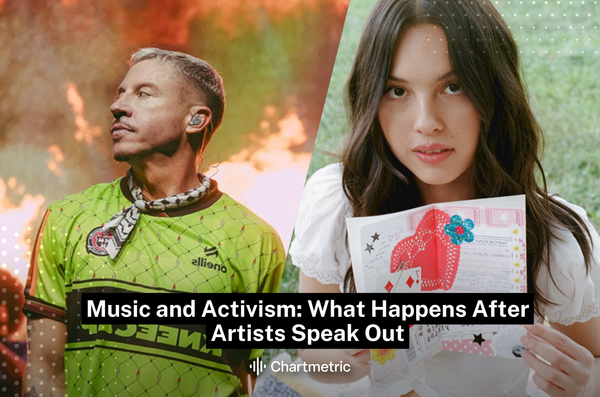
Of course, Sheeran recently made headlines for a similar scenario. On September 4, Macklemore shouted “Free Palestine” during his opening set for Sheeran’s Loop Tour. 10 days later, Macklemore was dropped from the tour.
As a result, Sheeran faced immense backlash on social media, and the rest of the opening acts left the tour as well. Sheeran put out a statement addressing the obligation and relief aspects of artist activism, while Sheeran and Macklemore saw both sides of how social media and activism can intertwine.
After being dropped from the tour, Macklemore gained 2.7 million Instagram followers in two weeks, increasing his total from 6.4 million to 9.1 million. In the same timeframe, his Spotify monthly listeners shot up from 33.8 million to 36.2 million. Conversely, Sheeran lost roughly 380k Instagram followers. His monthly listeners saw a downturn, but they have been trending down for months.
In 2026, when artists see the kind of surge Macklemore saw, new opportunities open for them, and on September 25, Macklemore announced his Free Palestine headlining tour. Could he have led that tour before the gain in numbers associated with his protest?
In many cases, protest songs perform exceptionally well in terms of data. Last year, Rolling Stone released a list of “The 100 Best Protest Songs of All Time.” It includes historic classics like Bob Dylan’s “Blowin’ in the Wind” and Creedence Clearwater Revival’s “Fortunate Son”. Of the 100 songs, 56% are in the performing artists’ top five Spotify streams. (Two on the list are not on Spotify, so the total measurable sample is 98. Of those 98, 51 are in the top five).
Furthermore, since that metric involves streaming, it suggests that the audience skews younger as opposed to people who grew up listening to those songs when they came out in the 1960s. Clearly, protest music has a timeless quality that’s also independent of genre. Modern rap hits like “Alright” by Kendrick Lamar are listed alongside one of the first protest songs ever recorded, Woodie Guthrie’s “This Land Is Your Land,” dating back to 1945.
The genre fluidity makes sense because the primary element of protest songs is the lyrics, and clearly those lyrics are timeless for an unfortunate reason.
“The issues that the singers are addressing, like racial inequality, are still here,” Brodsky says. And then because classic protest songs exist, as younger generations with streaming accounts continue to stand up for what they believe in, it’s easier to rally behind a song everyone knows rather than try to break a new song in the midst of a movement.
As a result of this dynamic, there are apparent data responses to certain crises among protest songs. For example, during the George Floyd protests in 2020, various protest songs saw significant surges. “Say It Loud, I’m Black and Proud” (1968) by James Brown saw a rise in Spotify popularity score from 36 to 64. “Fuck Tha Police” (1988) by N.W.A. reached #22 on Spotify’s US Viral Chart on June 1, 2020, and remained there for 11 days.
But the prevalence of older songs in these protests speaks to another element of how social media is influencing the culture of artist activism. When looking at Rolling Stone’s list, the 60s, 70s, and 80s have the most songs by far, with 18, 27, and 21, respectively. 66 total. More than half. This doesn’t seem surprising, as those decades are known for their historic activism, with the Summer of Love.
But as Brodsky pointed out, issues like war and racial inequality are still happening today. The difference is that because of social media, everyone is naturally focusing on the issues that are most important to them as individuals.
This isn’t a knock on modern generations to say they don’t care about what’s happening in the rest of the world. They simply grew up with technology that thrives on personalization. News feeds are delivered algorithmically to support one's own interests, causing people to seek out others who share their specific concerns.
Before social media and the internet, only the most ubiquitous issues spread universally through more limited means like television, radio, newspapers, and, most essentially, word of mouth. Such notoriety inevitably led to a greater collective response.
When artists have catalyzed collective responses to activist issues in the social media age, Brodsky contends that response comes from authenticity.
“A through line with audiences and how they relate to celebrities is that they have always wanted and will always want authenticity,” Brodsky says.
Megan Dembkowski, Vice President of Artist Relations at Infamous PR, speaks to activism from a point of view of image. She notes that activism is also a vehicle to connect with fans, despite the fact that there will always be certain people who disagree with any held views. “It's allowing them to talk about why they chose to do this. Why they chose to donate. Why these causes are important to them.”
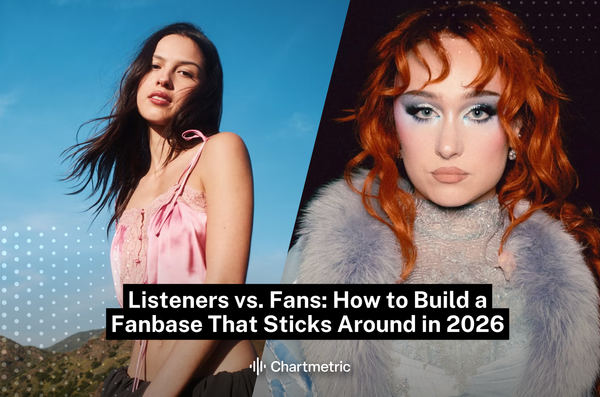
The most ambitious presentation of artist activism in 2026 was surely Daisy Chain Fields, Olivia Rodrigo’s charity festival. Her goal was to support women, so she partnered with numerous organizations focusing on women’s issues, and the lineup was 100% female, with every artist donating their fees to charity.
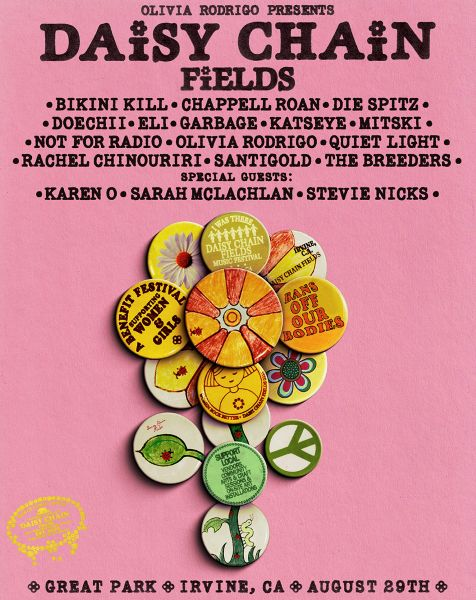
To emphasize her commitment, Rodrigo was up front promoting the event consistently. She modeled the merch, filmed videos alongside Planned Parenthood and other charities. Had she only cared about clout, she may have just shown up to take credit for raising $10 million with the event (that number was doubled by Melinda French Gates).
“Olivia Rodrigo is such a big pop superstar. I think [activism] also humanizes artists that are just so massive,” Dembkowski says. “It feels like you get to know them more in an intimate way if you know the causes that they stand up for.”
Brodsky attended Daisy Chain Fields and felt a similar authenticity throughout the event.
“It was just a really stunning solidarity to witness, whether you were there for the music or the activism angle,” Brodsky says. “It felt unusually safe. There were kids there with their parents. And I thought how special it would have been to go with my family to witness this. Because it is historic. I think that the idea itself came from the most sincere and genuine place.”
In terms of data, Rodrigo saw relatively modest increases around Daisy Chain Fields. She’s been on a universal uptick since April, when she announced her new album, you seem pretty sad for a girl so in love (2026), but after sharing the $10 million figure on August 28, she saw a bump of 1 million Spotify monthly listeners over the course of a month and an increase of 200k Instagram followers in the same time period.
So, like any activity as an artist, activism is not a surefire method of major long-term audience gains. Macklemore’s situation seems to be an outlier given the amount of drama attached. Rodrigo is a much bigger artist whose activities were much more ambitious than his, and her data response was quite modest. Lastly, as much backlash as Sheeran received, his true fans remained his fans.
All this to say, the positives of getting involved outweigh the negatives as long as the artist is approaching it authentically. Uninvested listeners may go elsewhere, but true fans will feel a stronger connection, and some artists might just make history along the way.