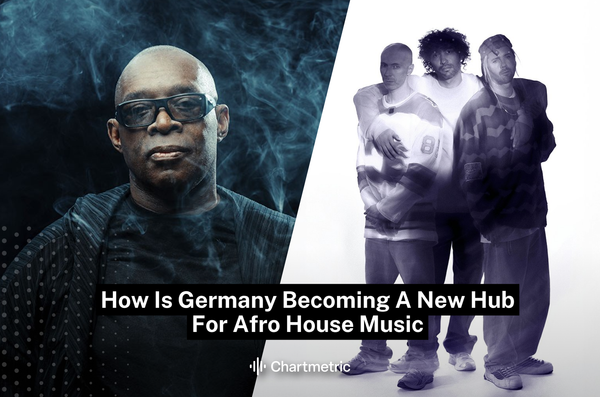
Germany's clubs have absorbed foreign sounds before and made them their own. A new data report suggests it may be happening again — this time with afro house — at the same moment techno, the genre most closely tied to Berlin's identity as a clubbing capital, is finding a second life on TikTok.
The shift, by the numbers
A joint report from the music-analytics platform Chartmetric and the sample library Splice, titled "Made First, Heard Second", identifies afro house as the clearest example in its dataset of what the authors call a "sonic hybrid genre" — one with no single dominant home market. The report's headline finding: the genre's largest market has moved from the United States to Germany.
Splice's own data backs up the momentum. In its "Sounds of 2026" report, released in January, the company named afro house its "Sound of the Year," pointing to a 778 percent year-over-year surge in downloads that pushed the genre from house music's fifth-most-downloaded subgenre in 2023 to second place in 2025, with roughly 6.7 million downloads and 1.3 million searches.
The Chartmetric/Splice report adds a timing detail worth noting for anyone trying to spot the next trend early: producer search demand for afro house on Splice rose 134 percent in 2022–23 and another 437 percent the year after, well before the genre registered among superstar-level artists on streaming platforms in mid-2024 — a reminder that what producers are searching for tends to predict what audiences will eventually hear.
None of this means afro house belongs to Germany, or that the US market has disappeared. But it does mean German promoters, labels and dancefloors are absorbing more of a genre that, on paper, is currently growing faster almost anywhere else in the world.
What afro house actually is
Afro house is a subgenre of house music with roots in South Africa's club scene, where producers in cities including Johannesburg, Soweto, Durban and Cape Town spent the late 1980s and 1990s blending house, kwaito and "tribal house" — uptempo tracks built around African percussion — with international deep and soulful house imported via vinyl. Its signature elements are call-and-response vocal arrangements, polyrhythmic percussion, and the use of traditional instruments such as djembes and shakers layered over a four-on-the-floor house beat. The genre proper, as a recognisably distinct label separate from kwaito and imported deep house, only really crystallised in the late 2000s and early 2010s.
There's no single inventor, but a handful of names come up repeatedly. Oscar "Oskido" Mdlongwa, co-founder of Kalawa Jazmee Records and the group Brothers of Peace, was among the first South African DJs to bring house to a national audience. DJ Christos, a Greek–South African selector active in Johannesburg since the late 1980s, helped build the city's early club infrastructure. Osunlade, a US-born, diaspora-based producer whose Yoruba Records label has connected African rhythmic traditions to the global house scene since the early 2000s, is often credited — alongside labels like Africanism — with laying groundwork that predates the South African "afro house" tag itself. And Black Coffee (Nkosinathi Innocent Maphumulo), the Durban-born DJ who won the 2022 Grammy for Best Dance/Electronic Album, is widely seen as the artist who carried the South African sound to a global stage. Berlin's own Keinemusik collective — &ME, Adam Port, Rampa and Reznik — has since become one of the genre's most visible European ambassadors, which is itself a small preview of the trend this article is about.
On the ground in Germany
A quick look at listings confirms the data isn't purely theoretical. Resident Advisor's Berlin page lists roughly a dozen events tagged "afro house" for August 2026 alone, alongside a recurring weekly night in Munich tagged both "afro house" and "deep house." Similar events turn up in Hamburg, Cologne, Düsseldorf, and Dortmund, plus a dedicated Afro Fusion Festival in Munich. The tag clusters frequently alongside afrobeats and amapiano — related but distinct strands of contemporary African-influenced dance and pop music — which suggests the on-the-ground picture is broader than a strict afro-house count would show, and that some sets and events featuring the sound simply aren't tagged with the genre name at all.
A familiar playbook: techno's Detroit-to-Berlin blueprint
If this pattern sounds familiar, that's understandable. Germany has absorbed and reinvented an imported American genre once already — with techno, in the 1990s. Techno was invented in Detroit in the early 1980s by Juan Atkins, Derrick May and Kevin Saunderson, the so-called Belleville Three, whose sound fused funk (Parliament-Funkadelic, George Clinton) with the electronic minimalism of Kraftwerk — an influence Atkins has repeatedly credited directly, including hearing Kraftwerk for the first time on Detroit radio DJ Electrifying Mojo's show. Eddie Fowlkes and Jeff Mills were close collaborators in that same first wave.
Berlin's Tresor nightclub, which opened in 1991, and the record store Hard Wax were central to bringing that Detroit sound across the Atlantic; Hard Wax's Mark Ernestus and Moritz von Oswald built direct relationships with Detroit artists and began booking them to play at Tresor; when the DJs came through, they often stayed at Ernestus's flat rather than a hotel, an informal arrangement that helped cement the relationship. Out of those connections came 3MB — "3 Men in Berlin" — a project pairing von Oswald and fellow Berliner Thomas Fehlmann with visiting Detroit producers including Juan Atkins and Eddie Fowlkes, whose recordings became some of Tresor's earliest and most emblematic releases. By the time of German reunification, Berlin had the empty industrial buildings and the cultural vacuum to make the sound its own — so much so that in 2024, "Techno Culture in Berlin" was formally added to Germany's National Inventory of Intangible Cultural Heritage, following a 13-year campaign by the nonprofit Rave The Planet.
Techno finds Gen Z (again)
The current afro house moment is unfolding alongside a parallel resurgence: techno is having a viral second act with a much younger audience, driven largely by TikTok, where hashtags like #RaveTok and #TechTok have turned rave footage, dress codes and mixes into a recurring content genre in Germany. That online wave appears to be spinning off — or running alongside — harder and more extreme hybrid strains such as dark techno and "hardtekk," genres that lean into distortion and speed rather than the minimalism of 1990s Berlin.
Hyperpop belongs in this conversation too, if only briefly: the Chartmetric/Splice report tracks it alongside afro house as one of its two clearest examples of the same "made first, heard second" pattern, with Splice searches for hyperpop growing 43 percent in 2022–23, another 55 percent the year after, and 37 percent after that — creator interest roughly tripling between 2022 and 2025 before the genre showed up in Chartmetric's mainstream-artist data. The genre dates to the early 2010s, growing out of the UK's PC Music collective, but it only reached a mass — and notably younger — audience after 2019, spreading largely through TikTok: the same platform now driving techno's rediscovery among Gen Z. The technoid edge doesn't seem to be a coincidence either — hyperpop's production toolkit leans on synth, arpeggio and side-chain techniques it shares with trance and Eurodance, and a loosely defined "hypertrance" fusion scene has since formed explicitly to bridge hyperpop nights with trance and Eurodance revivals.
Whose import is it? A more complicated question
There's a wrinkle in comparing afro house's German moment to techno's. As one academic study on German techno nostalgia has argued, retrospective German narratives about techno's Detroit roots tend to flatten out race: the scene gets remembered as a racially unmarked, implicitly white story. Hip-hop tells a different story, and it's worth being precise about how: the "Deutschrap" label itself was coined partly to mark German-language rap as distinct from its Black American original — but that act of separation didn't make the genre racially unmarked, it just relocated the marking. Scholarship on the German scene has documented the same move happening again inside Deutschrap itself, with critics coining a further label, "Oriental Hip-Hop," for its more explicitly Turkish-inflected strand — and the genre's most influential voices, from Advanced Chemistry in the 1990s onward, have disproportionately come out of Turkish and Arab migrant communities rather than, historically, Black German ones. Afro house, by contrast, carries its African origin directly in its name. Whether the genre's German uptake ends up crediting its South African originators, or gets absorbed the way techno's Detroit roots have sometimes been smoothed over in German retellings, is a live question worth watching as the sound gets bigger here — not a settled one.
The takeaway
Put together, the pieces at least point in the same direction. A fast-growing genre import (afro house), a viral rediscovery of the genre Germany already made its own (techno), and two pieces of policy and industry reform that — if they land as intended — would materially improve conditions for clubs and the artists who fill them: none of these four threads proves on its own that a broader revival of Germany's live club scene is underway. But they're converging at the same moment, which is itself notable, and it makes Germany's clubs — not just its streaming charts — worth watching over the next year.