
Coachella is more than a music festival. It’s a cultural touchstone. After the event continuously raised the bar with unique performances — Tupac’s digital resurrection, Outkast’s reunion in 2014, and Beychella (the colloquial name for Beyoncé’s titanic 2018 headlining slot) — being at the Empire Polo Club on the second or third weekend of April meant you were a part of history. And now global brands are clamoring to have someone on the ground to represent their products.
It remains the only festival in the world to consistently sell out two weekends with identical lineups. Other prominent festivals, such as Primavera Sound in Barcelona and Ultra Miami, tried and failed. The few other events that have sustained the format, such as Austin City Limits and Tomorrowland, rely on shifting around at least a few artists between editions.
Then in 2024, the impossible happened. Coachella ticket sales were slower than usual. It was one of the biggest stories of the year.
After the pandemic, Coachella, like almost every other festival in the world, had to take two years off (missing out on a Rage Against The Machine reunion booked for 2020). No one knew what live music, let alone the world, was going to look like when large-scale gatherings were permitted again.
One thing that Coachella quickly realized post-pandemic, even before the publicized dip in 2024, was that it was time to change. Since returning in 2022, the last five editions have seen significant shifts.
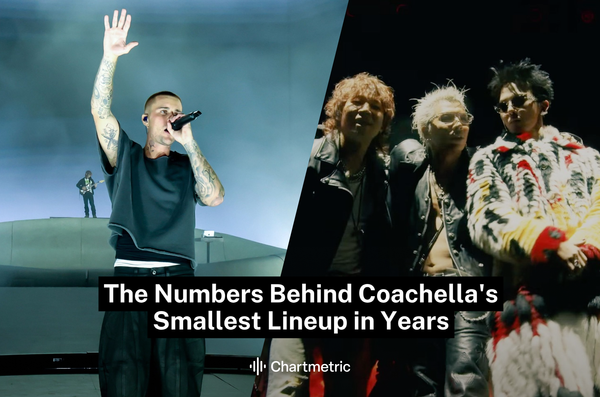
The most notable change is the sheer number of artists booked. 2022 saw an increase in artists on the initial lineup poster (the one with the same mountain range at the bottom), with 179 in total. This is up from 169 in 2018 and 166 in 2019. In 2026, the number has dropped by a whopping 40 artists, to 139.
Breaking that down by day, the 2022 roster had 60 artists performing on Friday, 61 on Saturday, and 57 on Sunday, with one extra coming from the newly added fourth headliner slot that isn’t attached to a specific day upon announcement. In 2026, those numbers drop to 51, 44, and 43, respectively.
The initial roster is only one side of this. The other side is the number of artists who actually end up on the final set times. Every year, the festival adds on artists to fill out the schedule, and in 2022, a new trend of adding massive artists to uncharacteristically early slots began when previous headliner Arcade Fire played a sunset show at a side stage. Since then, Ed Sheeran, Blink-182, Vampire Weekend, and this year, Jack White, have all been granted similar placements.
When all is said and done, the people who make it to Coachella always get more than what they paid for initially. In 2022, the set times had 196 and 197 artists for weekends 1 and 2, respectively. Yet, the numbers on the final schedule are also decreasing. For 2026, the set times had 151 for weekend 1 and 158 for weekend 2.
Another essential stat to mention is that ticket prices are consistently rising. In 2022, GA passes started at $449. In 2026, they were $549. Not the biggest bump over five years. But during that time, the grounds continue to grow, suggesting the event is increasing capacity as well.
This shift could very well be a net positive for artists. Fewer artists performing means a greater potential market share of viewers, both at the festival and on the YouTube stream for all the Couchella people out there. Chartmetric tracked the Spotify monthly listeners for every artist on the lineup between April 9, the day before weekend 1, and April 13, the Monday after. Some of the acts with the biggest growth were deep in the undercard.
UK dance duo, Prospa, was #14 with a gain of 210.6k. Looking at the set times, the last 30 minutes of their set only had one other artist playing at the same time. With that amount of openness, anyone who was still feeling the music after they were done crying at The xx would head over to Yuma, once again either on stream or in person.
KATSEYE, who were #1, may not have been undercard, but they were sharing time with only two other artists who are far less pop-leaning: Moby and Turnstile. So, for all the more general listeners out there, KATSEYE was the natural choice, which led to the girl group gaining 959.1k.
Coachella’s other tactics are seeing unique benefits for artists as well. For example, KATSEYE’s Instagram followers have increased by 40.2k in the days following their set. A modest bump out of their 8.5 million. On the other hand, Jack White, who has 1.2 million total followers, saw an increase of 20.6k following his performance. That includes a single-day gain of over 10k, which he’s only enjoyed five times in the last year. This represents a much larger gain by ratio compared to KATSEYE, due surely in part to the surprise nature of his booking.
For an overall perspective, in 2024, Chartmetric ran a study of how artist metrics were affected after both weekends compared to 2023. It measured Chartmetric score, Instagram followers, and Spotify monthly listeners. Slower sales and fewer artists in 2024 led to slower Instagram and Spotify gains, but larger Chartmetric score gains (Chartmetric score aggregates various measures of success on the platform).
In 2026, with even fewer artists, but a sold-out crowd (and resale tickets clearing $2,700), perhaps artists will see benefits across the board.
The question remains, though, if fewer and fewer artists are performing, where is the money from higher ticket prices going?
Well, it’s no secret that the cost of touring has increased “dramatically.” Coachella is likely investing more money per artist from the bottom to the top. On the other side, the cost of producing events has also become much more expensive, leading to dozens of festivals being canceled.
Coachella is surely feeling this pressure as well and has started investing money in new ways.
One of the likely endpoints for the money is putting more into the headliners. Regarding 2024’s slowness, many cited ”underwhelming” headliners (Lana Del Rey, Tyler, The Creator, and Doja Cat topped 2024).
In 2026, the biggest name is Justin Bieber, who was reportedly paid over $10 million. Beyond his own profile, these shows will be his first proper performances since 2022.
Another significant sum of Coachella’s money is also likely ending up behind the decks. The festival now has three stages dedicated to DJs: Yuma, Do LaB, and the most significant new musical offering post-pandemic: Quasar. This is where mainstage-worthy DJs play longer sets. The stage was introduced in 2024. Now in its third year, dance headliners such as Tiësto, David Guetta, and Diplo have played there.
All of these artists require a hefty fee, but the investment could very well end up in Coachella’s favor because of the minimal logistics involved. DJs only have to walk up and plug in their USB stick to perform, and the core element of Quasar is that every artist has the same production. DJs who play on the primary Coachella stages, such as Sahara, will design custom rigs just like bands.
Do LaB has also grown into another space for headline-level DJs. The golden era was back when Major Lazer or Skrillex would show up unannounced. Now, every special guest (there are generally six per weekend) is announced in advance, and serious names such as John Summit are taking these slots. Summit sold out a 51,000-seat stadium last year.
Plus, while the main Coachella roster is shrinking, Do LaB is growing. In 2022, Do LaB had a total of 45 artists spread over two weekends on the initial roster (which doesn’t count special guests). In 2026, 60 artists are booked.
Do LaB is its own event producer. So, surely Do LaB is contributing money to bookings, but with artists as big as Summit now playing there, it makes sense that Coachella is investing more than they have in the past.
This DJ emphasis could be seen as shirking the original values of the festival: lessening musical diversity in order to attract a more mainstream crowd. Certain critics have suggested that the 2024 dip was more the result of cultural degradation: the idea that influencers have taken over the festival for the sake of content and that true music fans are priced out.
However, Coachella 2026 sold out in less than a week. That’s hundreds of thousands of tickets over two weekends. The festival is certainly changing more rapidly than it ever has, but any shifts in investments or total artists are made to keep the festival afloat, and the festival still offers a unique and epic live music experience.