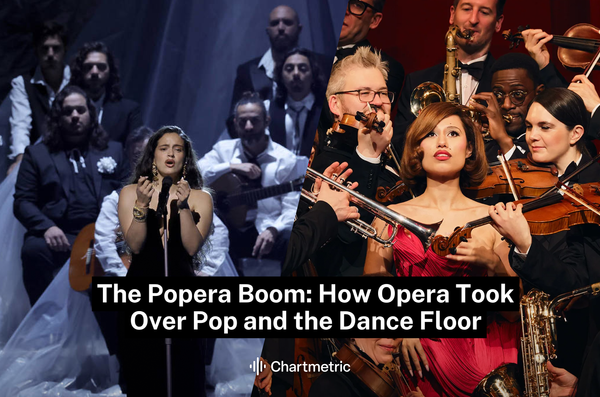

When ROSALÍA returned with the genre-defying ‘Berghain’ late last year, the Catalan star brought classical music, and specifically opera, to the masses. Within just one week of its release on October 27, her genre-defying collaboration with music icon Björk, underground outlier Yves Tumor and the London Symphony Orchestra (LSO) had clocked up 21 million streams on Spotify. Nestled among crowd-pleasers by pop superstars on editorially curated playlists, the comparatively challenging composition felt like something of an outlier.
The impact of ‘Berghain’
“Sitting alongside Taylor Swift in the Global Top 50 did more for opera's reach than decades of outreach campaigns,” begins Loren Sunderland, founder and editor of The Blank Mag. “People who would never have sought it out were suddenly hearing Vivaldi-style strings and operatic vocals, and that kind of accidental discovery is everything,” she continues. “It's honestly one of the most powerful things that could have happened for the classical world — you can't buy that kind of placement.”
‘Berghain’ proved equally popular (though uncharacteristically so) in the dance scene, thanks to household-name DJs the world over dropping the pace-shifting epic in their sets. Thanks to the likes of Fredagain.. and Four Tet, these moments took off on Instagram, and likely constituted the first time that opera has been heard on towering speakers in massive clubs.
For Sunderland, the most exciting aspect of the opera world attracting an entirely different, younger fan base is that “it happened with no gatekeeping at all. Four Tet and Fred Again... didn't frame it as a cultural moment, they just played it because it worked — and it did”, she says simply. “Those strings and ROSALÍA’s vocals fit perfectly into a peak-hours set; someone hearing it at 2am on a dancefloor isn't thinking about opera, they're just having one of the best moments of the night. That's how you bring new audiences in.”
Such wide-ranging exposure reached a cultural tipping point in February 2026. Just weeks after the Official Charts company in the UK launched its own Official Classical Chart, ROSALÍA’s performance at the BRIT Awards became the talking point of the ceremony. Viewed by 2M people in the UK, not only did the aforementioned Icelandic auteur Björk make an extremely rare live appearance, but videos of the ‘Berghain’ orchest-rave went viral. “It was like every genre of music in one song,” host comedian Jack Whitehall said on the night. “It started off all ‘Last Night of the Proms’, and by the end I was having a flashback to Pacha in Ibiza,” he joked of the singular rendition.
Chartmetric data shows that the original track has had more than 1BN views on TikTok, while, according to The Official Charts, sales and streams of both the song and its parent album ‘LUX’ rocketed over 300% week on week. ‘Berghain’, which now counts 144M Spotify streams, is ROSALÍA’s second most popular track on the platform. The BRITs-debuted techno remix by producer and DJ Conrad Taylor has also had an official release on Columbia Records; in just 10 days, it racked up nearly 2M streams on Spotify.
The (p)opera movement
Alongside ROSALÍA’s ‘LUX’ world tour, which features the 22-piece Heritage Orchestra centre-stage, another generational talent has been leaning fully into opera. In early April, RAYE scored her first UK number one album with THIS MUSIC MAY CONTAIN HOPE., which includes her second collaboration with Hans Zimmer ('Click Clack Symphony') and a pop music outing for one of Vivaldi's best-loved works. Published in 1723, the Italian Baroque composer's quartet of violin concertos, The Four Seasons, concludes with the icy ‘Winter’, an excerpt of which appears in RAYE’s track 'Winter Woman.’. The latter – which, like ‘Berghain’, features the London Symphony Orchestra – had been teased during a recent performance at The 02 in London where RAYE sang operatically over a violin solo by Kirsty Mangan.
Elsewhere, many household-name artists are taking inspiration from the classical world: the strings-led ‘Always Everywhere’ from Charli XCX’s ‘Wuthering Heights’ movie soundtrack has clocked up more than 20M streams, while Harry Styles’ emotional ballad ‘Coming Up Roses’ – the third most streamed song on his latest album ‘Kiss All The Time. Disco, Occasionally’ – is driven by a string orchestra arrangement
The recent album by Euphoria-soundtracking musician Labrinth, which itself features a fully operatic interlude track, is another case in point. Talking about the conception of ‘COSMIC OPERA ACT 1’, he explained his decision to incorporate classical composition in a recent interview with The Line of Best Fit. “Three or four years ago, it felt like nobody was messing around with classical,” he said. “There was no space for this sound or this experience.”
That’s certainly no longer the case, as proved by the most recent viral hit to incorporate elements of opera: ‘Fabulous’, by MEEK. Alongside clocking a massive 5.78M TikTok views in just over one month, it soars thanks to the Londoner’s operatic-style vocal. This online success has translated to success on DSPs too, with the song having reached over 6M streams on Spotify. According to Chartmetric data, as of February 17, ‘Fabulous’ (CM recent momentum ‘explosive growth’) had an editorial playlist reach on the platform of 12.4M, while her YouTube views increased by 251.3K during the week of Feb 15-22.
Another fresh release that could follow suit is Emei’s theatrical new single, ‘Night at the Opera’, which has two strings arrangers (Ricky Reed and Cheche Alara) listed on the song credits on Spotify. “I like the notion of the vocabulary of opera being absorbed into the world of pop, and I think that's what's happening,” Sunderland analyses. “What is so great about all of those artists is that none of them is asking audiences to sit through a three-hour production, but they're all borrowing opera's drama and grandeur.”
On an instrumental level, she attests that “strings provide this, moving between seriousness and vulnerability simultaneously”, considering that “this is exactly the emotional territory the most interesting artists are trying to explore right now”. Sunderland also feels that because genres are “existing less and less,” artists now have greater freedom to experiment with orchestral textures. Not only that, but there is “far less commercial risk than ever before”.
The live effect
She feels that this extends to the live realm, where classical’s crossover has been building for some time. As Chartmetric reported last April – when the Los Angeles Philharmonic performed with Laufey, LL Cool J and Zedd at Coachella – there has been a growing intersection of orchestral music with pop, hip-hop, and electronic genres. In the time since, even more artists have been incorporating operatic and classical elements into their live shows, most notably Lady Gaga’s MAYHEM ball tour which was hailed as a “pop-rock opera” by the London Evening Standard. More recently, the opening act of Lily Allen’s intimate ‘West End Girl’ UK theatre tour has seen a three-piece string ensemble perform her biggest hits with the lyrics on screen ready for the audience to sing karaoke-style.
Sunderland hones in on these examples – as well as ROSALÍA’s current “work of art” ‘LUX’ world tour – to suggest that “the real commercial opportunity lies in live performance”, namely theatrical shows that justify premium ticket prices. “I think we're heading toward arenas filled with operatically-influenced experiences,” she predicts. Sunderland also foreshadows that “classical institutions will see a wave of newly curious visitors”.
Part of classical music's appeal, perhaps, lies in exactly what makes it irreplaceable: a centuries-old legacy built on human craft, emotional depth, and the kind of authenticity that can't be manufactured. That tension has not gone unnoticed. In a recent interview with Crack magazine, classical musician and broadcaster Linton Stephens analysed this pivot as a response, or even rebuttal, to the increasing prevalence of AI in the music industry. “Instrumental collaboration from the orchestral world reminds us that it’s authentically human-made.” Sunderland tends to agree: “There’s something about a room full of musicians responding to each other in real time that AI genuinely can't replicate”. She raises another prescient point — “I think the more interesting question is whether AI will actually push orchestral music to become more itself… more improvisational, more about the unrepeatable live moment”.
Whether opera is dominating today purely due to a shift in taste, or as a deeper anxiety about an industry threatened by automation, might be up for discussion. What isn't is that classical music has made an undeniable mark on mainstream music. From a different angle, this could mean a positive change for artists, encouraging them to be more experimental with their sound. Without strict sonic guidelines dictating what makes a song a "hit" or pushes it into the "mainstream," the long-standing line separating experimental music from commercial viability starts to blur. For many artists, emerging or established, that might be the most exciting development of all.