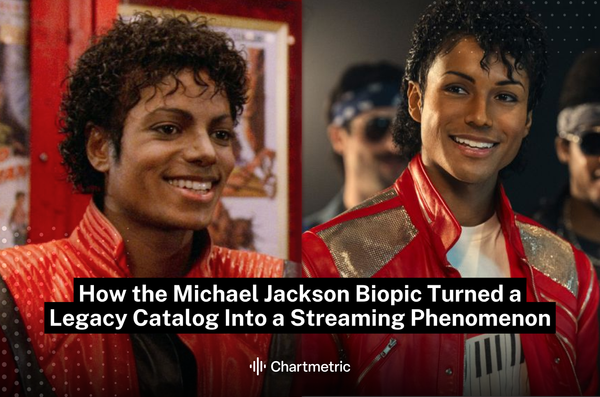
When Michael, the biopic centered on Michael Jackson’s early life, premiered on April 24, 2026, expectations were massive. But even by blockbuster standards, the streaming response has been extraordinary.
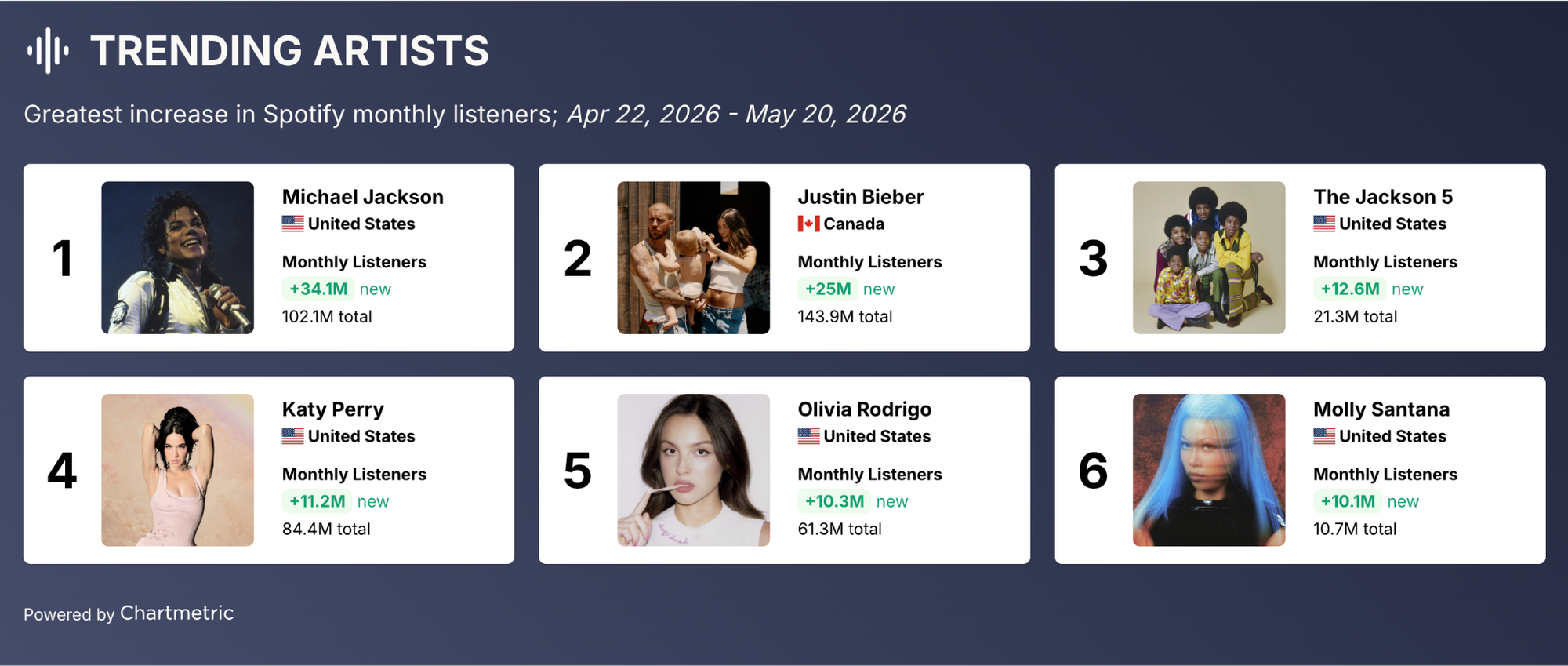
Less than a month later, Jackson now sits at number 1 on Chartmetric’s trending artists, and The Jackson 5 sit closely after him at number 3. With Michael sitting at 102.1M Spotify monthly listeners, the highest audience level of his streaming era, this impact extends far beyond nostalgia. The catalog revival isn’t simply driven by older listeners chiming in. Rather, this resurgence operates at a modern, living pop-star level, supported by algorithmic discovery, playlist ecosystems, and new audiences.
A Catalog Explosion at Streaming Scale
Michael Jackson’s streaming growth had already been stable before the film’s release. Between April 2024 and April 2025, his monthly listeners grew by a respectable 8%. But after Michael hit theaters, that trajectory accelerated almost instantly.
In the four weeks following release, Jackson gained roughly 40 million monthly listeners, surging from around 62 million to over 102 million. That represents a staggering 121% increase year-over-year, up from 46.1 million listeners in April 2025. His Spotify follower count has also exploded, rising from 29.6 million in January 2024 to 43.5 million today, an increase of nearly 14 million followers in less than a year and a half.
Interestingly, two smaller inflection points appeared before the movie itself arrived. The first occurred around October and November 2024, coinciding with the film’s originally planned release window. Another spike occurred between September and November 2025, following the release of trailers and widespread news coverage of the project’s delay. So even before audiences entered theaters, anticipation and marketing efforts were already reactivating the catalog.
But once the film actually premiered, the scale became unprecedented. Across Jackson’s top 60 tracks, streams jumped from 467 million plays in the month before release to 1.21 billion plays afterward. That is roughly 748 million additional streams in under four weeks.
The biggest classics naturally benefited. “Billie Jean” climbed from 53.9 million to 130.4 million plays post-release, while “Beat It” went from 35.8 million to 100.6 million. Yet some of the most dramatic gains came from deeper cuts and non-obvious catalog entries. For example, “Human Nature” experienced a massive 6.4x increase, jumping from 9.8 million to 63.1 million plays. “Bad” rose 4.4x. “Don’t Stop ‘Til You Get Enough” nearly quadrupled. Even tracks like “Workin’ Day and Night” and “Dangerous” saw major acceleration. What we see here is that listeners were on a discovery journey that went beyond chiming in on the classic hits. Instead, they went exploring in Jackson’s catalog.
One particularly unusual wrinkle has emerged around “Thriller.” The version attached to the new Michael: Songs From The Motion Picture soundtrack is a separate Spotify upload from the original recording, serving as a parallel catalog product. Since its release, that upload alone has generated roughly 910 million plays. This also sheds light on how soundtrack repackaging can create entirely new streaming lifecycles for legacy material.
Editorial Playlists Fuel the Surge
Playlisting also played a huge role in amplifying the biopic’s momentum. Before Michael's release, the late artist's tracks received just 30 playlist adds across 22 playlists during two months. Following release, that number exploded to 374 adds across 134 playlists.
In total, post-biopic placements reached a combined audience of nearly 119 million playlist followers. Spotify editorial support was particularly aggressive. Jackson appeared across 26 editorial playlists totaling nearly 50 million followers, including major placements on Top 50 Global, Top 50 USA, Top 50 UK, Top 50 Germany, and many more.
Notably, Spotify refreshed flagship nostalgia playlists like All Out 70s, All Out 80s, and All Out 90s just five days after the film’s release, integrating multiple Jackson tracks simultaneously. The effect was powerful: the world’s most recognizable catalog was suddenly being algorithmically redistributed back into everyday listening behavior at a huge scale, leading to the huge resurgence we’re witnessing today.
Global Growth
Could it even be possible that the iconic global pop-star becomes even more global following the biopic? The answer is yes.
While the United States remains Jackson’s largest individual market, the geography of his audience is shifting noticeably. The US share of his Spotify audience declined slightly from 30.4% to 28.3% during the post-release period. Meanwhile, Latin America collectively grew from 33.5% to 35.3%, surpassing the US as the largest regional bloc in Jackson’s audience. Brazil alone now represents 14% of his global listener base, while Mexico overtook India to become his third-largest market. Spain experienced one of the fastest relative growth rates, increasing by 27%.
At the city level, the trend becomes even clearer. Michael Jackson’s five largest Spotify cities are now Mexico City, London, São Paulo, Santiago, and Sydney, all of which have nearly doubled year-over-year. So while the biopic is rooted in American pop mythology, its streaming revival is deeply global.
A Younger Audience Than Expected
Perhaps the most revealing aspect of the resurgence is who's actually listening. Chartmetric's audience data shows that 82% of Michael Jackson's listeners are under 35 years old. His largest demographic is the 25–34 age bracket, which alone accounts for 45% of his total audience. On Instagram, the young skew is even more pronounced: both the 18–24 and 25–34 brackets each roughly represent 40% of his followers.
That framing matters. The streaming response to Michael doesn’t resemble a traditional nostalgia cycle driven primarily by older fans revisiting familiar music. Instead, the data suggests the biopic is functioning as a discovery mechanism for entirely new and younger generations. In many ways, the film has reintroduced Michael Jackson as an active participant in today’s streaming sphere rather than just a legacy artist. And that may be the most significant takeaway of all.
Catalog music has always had longevity. But in the streaming era, longevity alone is no longer enough to explain this level of acceleration. What Michael demonstrates is that when legacy catalogs are paired with large-scale cultural moments like films, virality, playlists, and algorithmic exposure, they can compete directly with contemporary releases at the very top of the market.
Now, nearly two decades after his last studio album, Michael Jackson isn’t merely surviving on streaming. He’s scaling like a modern superstar all over again.