
If 2024 was a sprinkle-topped strawberry sundae filled with Charli XCX’s slime-green Brat summer, Sabrina Carpenter’s 2.89-billion-streamed “Espresso” shot, and Chappell Roan’s megawatt Grammy moment, then 2025 was the store-bought ham sandwich you eat alone on your lunch break: slightly stale.
Last year was notably lacking in breakout hits and chart-topping new singles, with only 23 tracks cracking the top charts in the first half of 2025, versus 49 during the same period in the previous year. And the holdover hangover hasn’t lifted; 2026 has also got off to a historically slow start for new releases. In January, current-year tracks claimed just a 3.5% share of Spotify’s Global Top 50 chart—falling below the previous three Januaries: 26% in January 2025 (a significant spurt thanks to the release of Bad Bunny's DeBÍ TiRAR MáS FOToS that month), 9.4% for January 2024, and 8.4% for January 2023.
The same data shows us that 2023 and 2024 were generally healthier years for new music dominating the chart, with current-year tracks sitting above 64% from June onwards and 2024 peaking at 72.8% in October. Yet despite 2025’s misleading Bad Bunny spike, from April onwards, new releases consistently underperformed. It was a stagnant year marked by holdover hits: the traditionally upbeat song of the summer was nowhere to be found, while just three of Spotify’s Top 10 biggest-streamed songs were released that year, according to Chartmetric’s Year in Music 2025 report: “Ordinary” by Alex Warren (1.5b), “DtMF” by Bad Bunny (1.3b), and “Golden” by HUNTR/X (1.2b) from the blockbuster Netflix film K-Pop Demon Hunters.
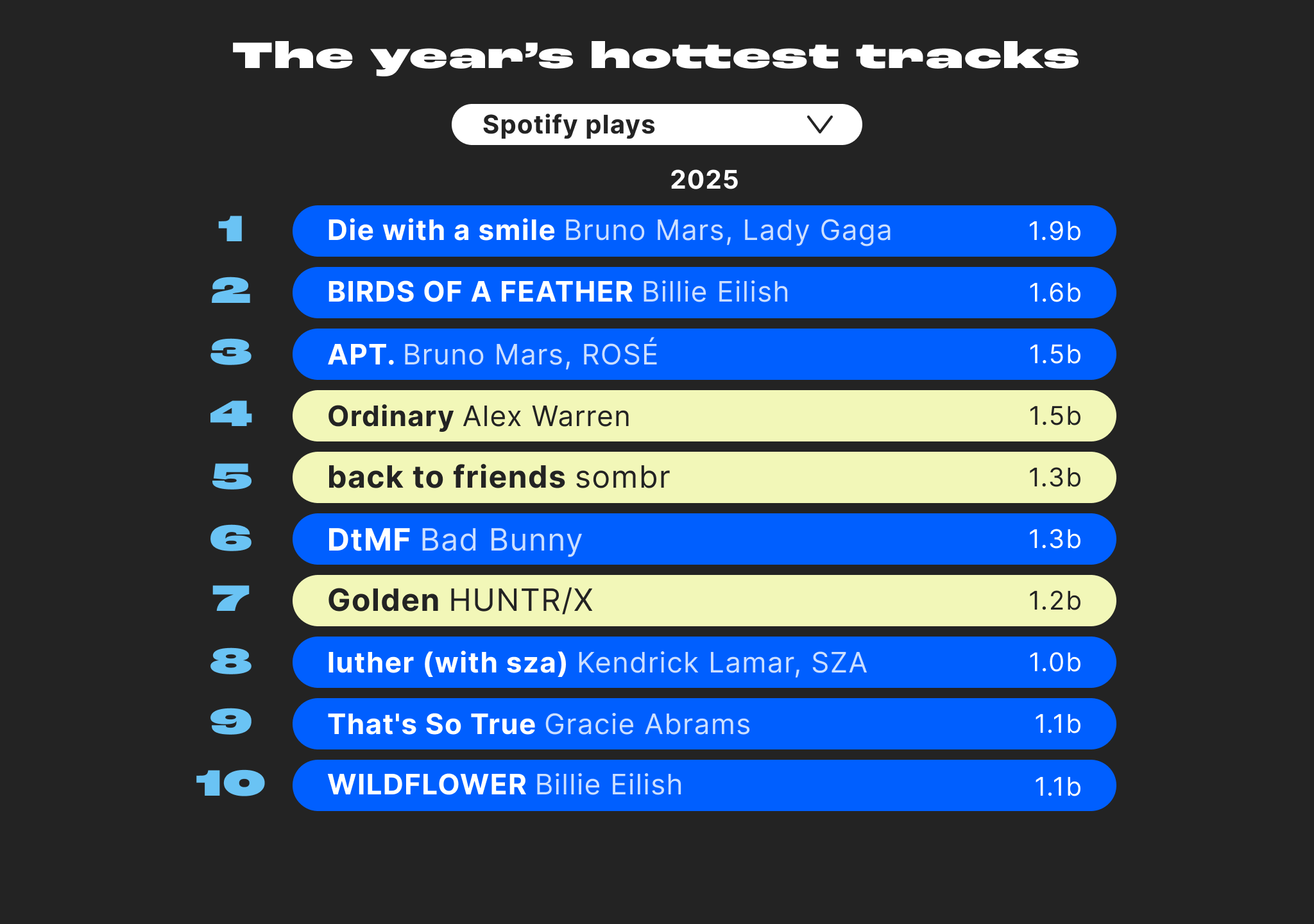
This stickiness in 2025 appears to have persisted into early 2026: Taylor Swift’s "The Fate of Ophelia" (October 2025), "Golden" by HUNTR/X (June 2025), and "back to friends" by sombr (December 2024) all hung onto Top 50 positions throughout January while a catalog resurgence—part of the nostalgia phenomenon boosted by TikTok— brought back throwbacks from Zara Larsson (2015), Dominic Fike (2018), and even The Police (1983).
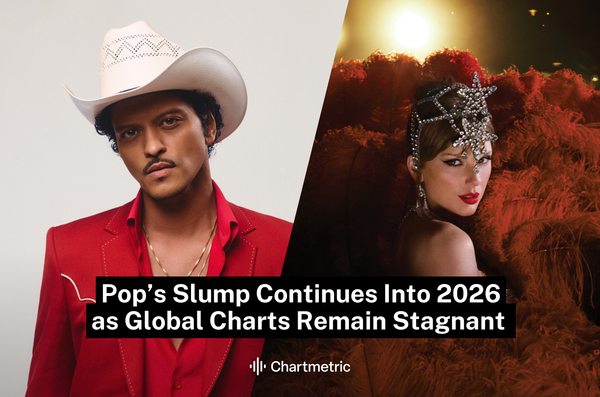
The new releases that did drop seemed to lack crossover pop appeal. A$AP Rocky's and Don Toliver's hip-hop-leaning albums each only held Top 50 positions for 1-2 days — spiking on release day and dropping off. Even Bruno Mars' project, The Romantic, failed to replicate the success of his 2024 fixtures. But March has seen a sharp acceleration — 65.7% of distinct Top 10 tracks in March were new releases, driven by BTS's ARIRANG and Harry Styles' latest album.
In total, 197 distinct tracks have appeared in the Spotify Global Top 50 during Q1 2026. Of these, 116 were holdovers, and just 81 were new releases. In Q1 2024 and 2025, the numbers were split much more evenly.
The generational wave that broke
Tom Breihan, a music journalist and author of The Number Ones: Twenty Chart-Topping Hits That Reveal the History of Pop Music, agrees that 2024 was marked by a short-lived boom in fresh pop voices. “It's just a little generational wave that we got, and then it seems to have ebbed away,” he says, likening 2024 to 1984, a year widely considered to be one of pop’s greatest. “I haven't seen the arrival of someone who I'm like, ‘Oh, it's another new superstar,’” he adds.
Several interconnected factors could explain the stasis, with cultural fragmentation notably accounting for much of this “ebb.” These days, music consumption is scattered across multiple platforms, from TikTok and Instagram to YouTube, thus largely dissolving the shared monoculture that once helped to launch new stars. “We're all living in our own little bubbles now, and so some songs break through and end up being common to a lot of people, but it's not quite the same because we're not all tuning into the same spots,” observes Dr. Jada Watson, an associate professor of digital humanities at the University of Ottawa whose research has covered representation on radio programming and popularity charts.
Watson says she noticed this fragmentation making its way into the pop music discourse around 2025. “I think what was interesting to me was listening to the media talk about songs of the summer, and hearing different segments of the media be like, ‘I've never heard “Die With A Smile” on the radio, but it’s somehow at the top of the charts’.”
Secondly, the sheer volume of recorded music online simply makes it difficult for most newer songs to get a look in. “One can't stand out in this digital economy that we have right now,” continues Watson, speaking to the difficulty in ascending to song of the summer status when so many tunes are getting the same kind of engagement. Chartmetric logged 29,539 releases every single day last year. And as Breihan puts it, “every new song is competing with every old song.”
Thirdly, streaming’s immortality problem means tracks enjoy a seemingly infinite shelf life. Unlike radio, where songs tended to have a finite life cycle on the airwaves before getting swapped out for a newer release, streaming platforms allow tracks to outstay their welcome. Evergreen editorial playlists like Spotify’s leading Today’s Top Hits (followed by 34.4M people) feed into this familiarity, where songs can stick around for weeks if they’re performing well.
Watson notes this concentration at the top isn’t necessarily a new phenomenon. “There's sort of this pattern that happens in that—pretty much regardless of the format—it's only ever a handful of songs that get high repetitive rotation.” However, the difference now is that this handful never shifts, resulting in chart stagnation.
Superstar dominance
The reality is that it’s becoming increasingly difficult for tracks to reach the top of the charts. “Most of the songs that are up in the upper level are these sort of superstar event songs that debut up at the top and then either fall down or stay around,” suggests Breihan.
“Die With A Smile” exemplifies this superstar dominance. After debuting in August 2024, it immediately hit the jackpot, claiming the Billboard Hot 100 crown for five non-consecutive weeks and becoming Spotify’s longest-serving daily number one song in the streaming platform’s history.
However, over in the mainstream charts, “Die With A Smile” became the first victim of Billboard’s long-awaited shake-up last October, ending the track’s 60-week stay on the Billboard Hot 100 following the introduction of the media brand’s new recurrent rules. Previously, descending songs were removed from the Hot 100 once falling below number 25 after 52 weeks or below number 50 after 20 weeks. Now descending songs will drop off if they go below number five after 78 weeks, below number 10 after 52 weeks, below number 25 after 26 weeks and below number 50 after 20 weeks. It seems like the rule change was needed to at least give the impression of a more equitable system.
Breihan describes the rule change as a “very good thing … I think if a song has been up there for eight months or something, it can drop off, because otherwise, you get these songs that just seem to stay up there forever.”
Statistics from 2025 show that only a quarter of music streams account for newer tracks; the rest of the market belongs to catalog music (defined as anything older than 18 months from their release date), reiterating the difficulty newer songs have in pretty much competing with the entire history of recorded music. Huge numbers are needed to get to the top and only a tiny fraction of songs break through massively. Last year, the average time it took to hit the billion-stream mark dropped from 2,729 days in 2015 to just 197 days. For example, Lady Gaga and Bruno Mars’ “Die With A Smile,” released in August 2024, broke the Spotify record for the fastest song to reach one billion streams, achieving the milestone in just 96 days on November 20, 2024. This essentially means these megahits are scooping a much bigger slice of the pie.
Watson acknowledges the nuances of measuring success in today’s landscape. “I think I sometimes see it from both sides, which is that on the one hand, things should move faster, because it means that new people could come in and enter the game and have a greater chance for opportunity. On the other hand, if there's truth to the numbers, and that song really is the most listened to, then of course it should be, so I can't even win in my own head.”
As the way we consume music in 2026 continues to become increasingly atomised, and algorithm-backed catalog releases are given weight over new tracks, up-and-coming artists will likely find it tougher to break through and build an audience. The goalposts of hitmaking have shifted. A hit song once had a clear arc—now songs chart for longer without one. But longevity is no longer a reliable barometer of popularity. With the charts slowing down and new entries eclipsed by holdover hits, how do we know what’s even popular anymore?