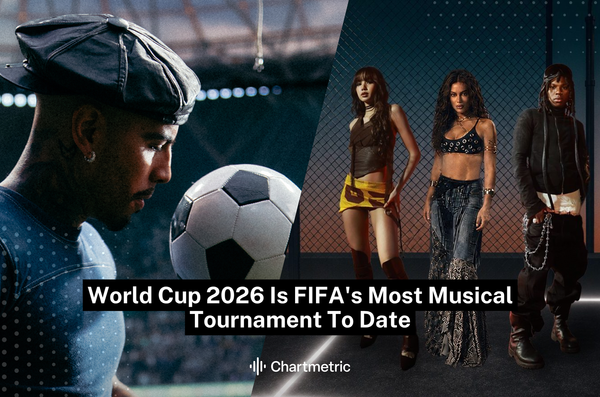

Jointly staged by the United States, Mexico and Canada, this year’s 48-strong World Cup is the most expansive – both geographically and competitively – in the soccer tournament’s history. And thanks to the glut of new songs designed to inspire sporting glory, it’s also by far the most musical.
That’s perhaps little surprise considering USA also upped the razzmatazz the last time they played hosts. Who can forget Diana Ross’ missing a penalty during the opening ceremony performance? 1994 was also the year that the sport’s governing body FIFA first released an accompanying album, Gloryland, with Daryl Hall and Sounds of Blackness’ title track – sadly absent from streaming – serving as the official theme.
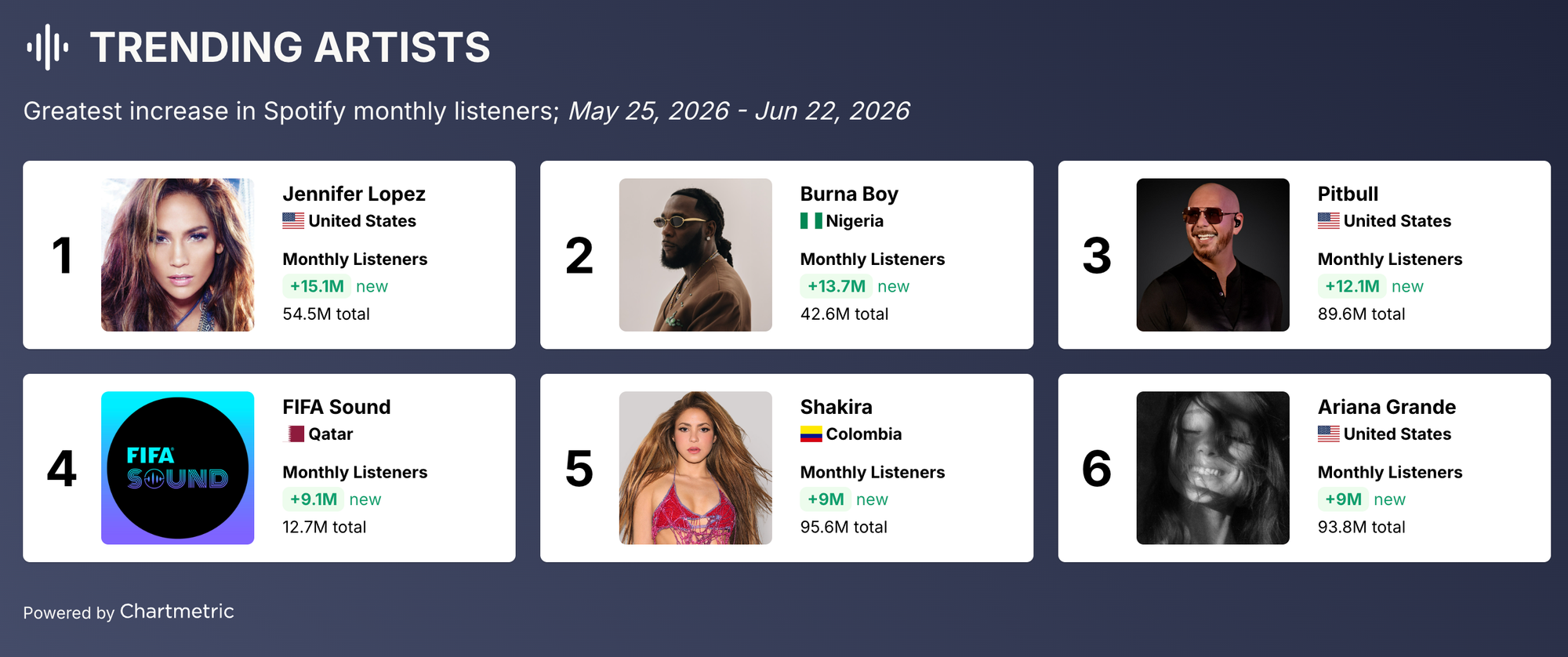
But 32 years later, the World Cup soundtrack has become far more global. This year, a dozen artists have joined forces to support their respective national teams, many releasing music under the collective FIFA Sound banner on platforms like Spotify. Nearly a week after the tournament's opening match, FIFA Sound ranks as Spotify's fourth-fastest-growing artist by monthly listener growth.
A Tournament Soundtracked By The World
This year's tournament has inspired a wave of songs from artists, broadcasters, brands, football federations, and FIFA itself.
In Colombia, Luis Alfonso and Pipe Bueno joined forces for “Te Quiero Ver Campeón” (590k Spotify streams), while one of the country’s premier vallenato singers, Silvestre Dangond, even managed to bag star player Luis Díaz for the video to “Ganas de Tenerla” (1.6m).
Elsewhere, Flemish singer Sylvie Kreusch has joined forces with rapper Roméo Elvis to spur on Belgium with “Kiss the Grass (Allez Allez)” (116k). Journalist-turned-synthpop maestro JJ Bull‘s “Very Unofficial World Cup Song” (39k) is currently the most popular musical number backing Scotland’s first appearance since 1998.
Brands have also embraced the tournament's growing musical ecosystem. Coca-Cola assembled the unlikely dream team of J Balvin, Amber Mark, Travis Barker, and Steve Vai for a cover of Van Halen’s “Jump” (2.1m). Another longtime sponsor, Adidas, recruited Japanese superstar Ado for “Kira” (the only artist in this year’s offering whose audience skews female), while Buchanan's Blended Scotch Whisky tapped Rauw Alejandro for “Dando Vueltas” (4.4m), a celebration of the Latino community’s relationship with the sport.
Then there’s the Canada Soccer Foundation, who’ve gone the extra mile by recording an entire album, Perfect Pitch, for the occasion with some of its most high-profile musical ambassadors. Nelly Furtado and Boi-1da's “Electric Circus” looks set to be its breakout hit, racking up 1.4m streams since its April release. Interestingly, it’s this year’s only partisan offering whose dominant listenership comes from outside its home territory, with 31.6% hailing from USA (Canada is even behind Brazil, Mexico, and the UK).
Several songs are enjoying a new lease of life having been repurposed for the terraces, too. While Dubioza kolektiv’s “USA” was written about the fallacy of the American Dream, the 2011 track has racked up 2.1 million streams, a sixth of its overall total, since the band’s native Bosnia beat Italy to book their place in March’s playoff. Further buoyed by a re-recorded version that’s also about to pass the one million mark, the group’s YouTube monthly audience has grown from 1.48m to a whopping 1.93m.
FIFA's Biggest Musical Ambition Yet
As always, FIFA are throwing their hats into the ring as well. Continuing to advocate that ‘bigger is better,’ FIFA invited one act from each of the 16 host cities to stamp their mark on the official theme for the Official FIFA World Cup 2026 Host City Themes project.
Nevertheless, it's the official FIFA World Cup 2026 album which has so far spawned the most attention, if not always for the right reasons.
Responses to Belinda and Los Angeles Azules’ "Por Ella”" (4.1 million streams), Jessie Reyez and Elyanna’s “Illuminate”, and Daddy Yankee and Shenseea’s “Echo” (1.1m) have generally been positive. As one of the least globally familiar contributors, Elyanna has perhaps benefited the most from the exposure with a Chartmetric rank that's risen from 4.3k to 1.7k, a significant spike in TikTok likes (30.9m to 32.3m), and a surge in Wikipedia page views (377 to 12.1k) as intrigued audiences further delve into the Chilean-Palestinian's talents.
Still, arguable the biggest talking point this year has been Jelly Roll and Carin Leon’s “Lighter”.
The collaboration has amassed 6.2 million streams, making it the second most-played official song of the tournament so far. Yet despite those numbers, critics have described it as an awkward fit for the world's biggest sporting event, with some social media users calling for the World Cup itself to be canceled.
Its commercial performance remains impressive. "Lighter" has already surpassed official themes such as Anastacia's "Boom" from Korea/Japan 2002 and Il Divo and Toni Braxton's "The Time of Our Lives" from Germany 2006, but it looks unlikely to join the big league of FIFA anthems.
The Impossible Standard Set By Previous World Cups
Indeed, at the same pre-kick off stage at Qatar ‘22, Ozuna’s “Arhbo” had already reached 10m streams. Released on the same day the tournament got underway, meanwhile, Jung Kook’s “Dreamers” went on to record a colossal 528.9m. Although FIFA didn’t release a full-length album for Russia ‘18, the sole new offering – Nicky Jam, Will Smith and Era Istrefi’s “Live It Up” – on its playlist alternative was streamed 165.6 million times. And living up to his Mr. Worldwide nickname, Pitbull and Jennifer Lopez’s anthem for Brazil ‘14, “We Are One (Ola Ola),” became a global smash with 422m streams.
The mother of all official tie-ins, however, arrived at South Africa ‘10 by an artist whose Colombian homeland hadn’t even qualified. Shakira’s “Waka Waka (This Time for Africa),” an impossibly addictive collaboration with local Afro-fusion collective Freshlyground, became the first World Cup song to join Spotify’s Billions Club last year. Furthermore, it sold 15 million digital copies and as of 2025, its music video is the ninth most watched in YouTube history. Remarkably, on the Hot 100, it never reached higher than No.38.
Shakira also reworked the lead single from her eponymous 10th album, “Dare (La La La),” for Brazil ‘14, with the Carlinhos Brown-featuring “La La La” (185.6m) outstreaming the original (85.4m) and has just dropped her third World Cup anthem, a typically bouncy collaboration with Burna Boy titled “Dai Dai.” Unsurprisingly, it's skyrocketed to the top of this year's table, amassing 69.7m Spotify streams, 368.3m TikTok views, and 4m YouTube likes in a matter of weeks.
The World Cup and Beyond
Some of the biggest World Cup songs weren't FIFA songs at all.
K'Naan's Coca-Cola anthem "Wavin' Flag" became a global phenomenon whose various versions comfortably exceed one billion streams combined. Vegedream's "Ramenez la coupe à la maison," recorded to celebrate France's 2018 triumph, has surpassed 600 million streams despite remaining largely unknown outside the French-speaking world.
Magic System's "Magic in the Air" has amassed 254 million streams and became inseparable from France's World Cup celebrations in Russia. Even IShowSpeed's unofficial "World Cup" has reached 96.5 million streams, making it one of Qatar 2022's biggest musical success stories.
This is what makes successful World Cup songs so difficult to predict.
Some tracks arrive with superstar names and multimillion-dollar marketing campaigns only to disappear by the final whistle. Others emerge organically from terraces, television broadcasts, and viral moments to become inseparable from the tournament itself.
The chances of predicting which song will define United 26 are slimmer than Cape Verde lifting the trophy. But whether it's a FIFA-sanctioned anthem, a sponsor-backed collaboration, or an unexpected fan favorite, history suggests one thing is certain: every World Cup eventually finds its soundtrack.