
We’re excited to share our latest report, The New Sound of Global Music, exploring how five major music markets—Mexico, Japan, Brazil, India, and Nigeria—are growing beyond their borders.
The globalization of music has never been more visible or more difficult to define. Streaming platforms have made virtually every song available to listeners around the world, but global availability doesn’t necessarily translate into sustained international success. Some markets are building powerful regional networks, others are reaching listeners through diaspora communities and digital fandoms, while some have domestic ecosystems large enough to sustain major artists largely at home.
By analyzing foreign chart activity, audience geography, and artist growth, the report explores the different ways music is traveling across borders and reveals that there is no single blueprint for international success.
Here’s a sneak peek at some of the report’s main takeaways:
Mexico Has Built a Blueprint for Regional Globalization
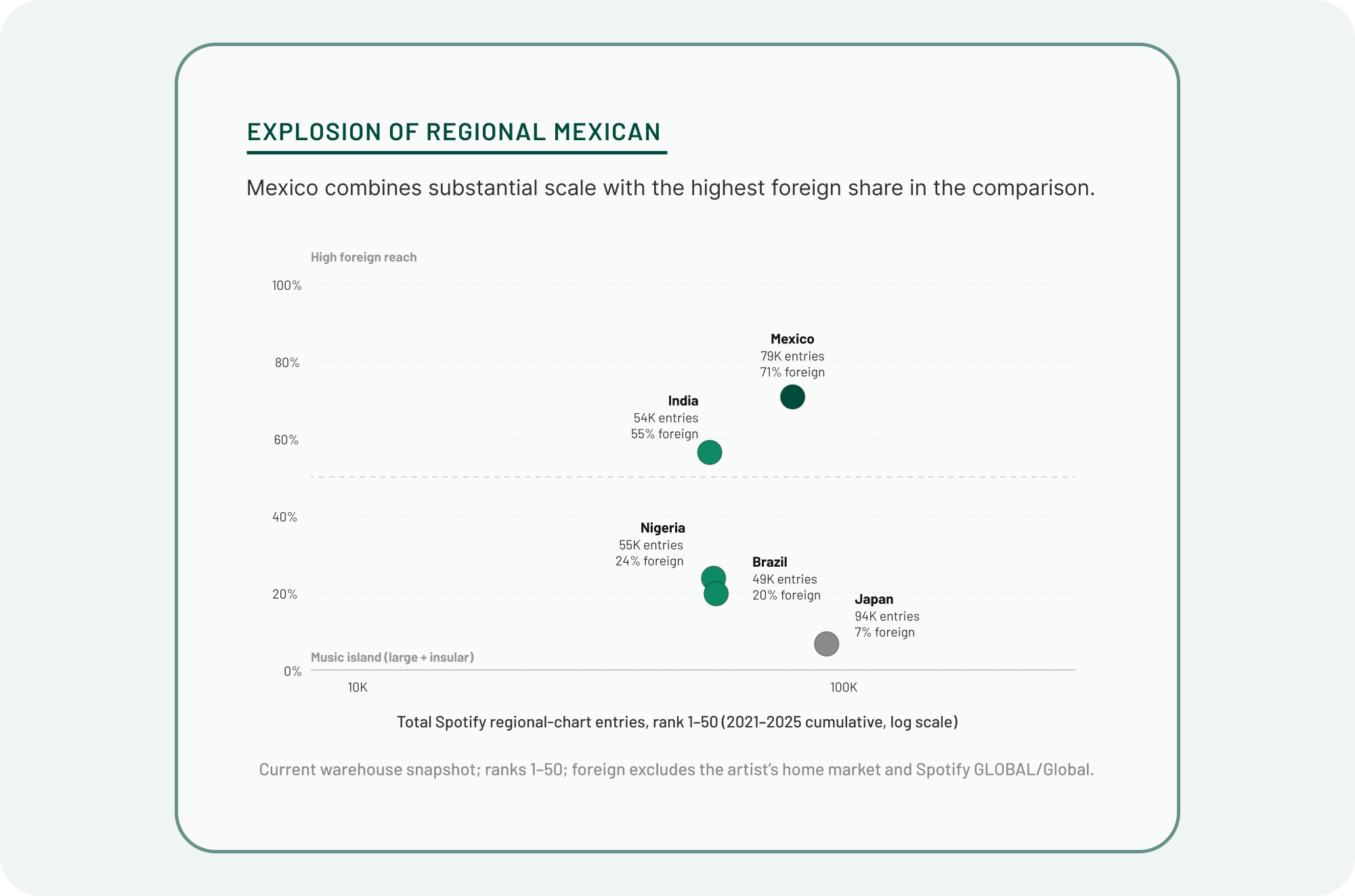
Mexico has developed one of the strongest cross-border music ecosystems in our analysis. Between 2021 and 2025, 71% of Mexico’s Spotify regional-chart entries ranked 1–50 appeared in foreign markets, the highest share among the five countries studied.
At the center of this growth is regional Mexican music. Corridos and corridos tumbados have expanded well beyond Mexico, building sustained audiences across the U.S. and Latin America. Markets including Colombia, Peru, Ecuador, Argentina, the Dominican Republic, and Venezuela have become important destinations for Mexican artists.
Japan’s Massive Music Market Is Slowly Looking Outward
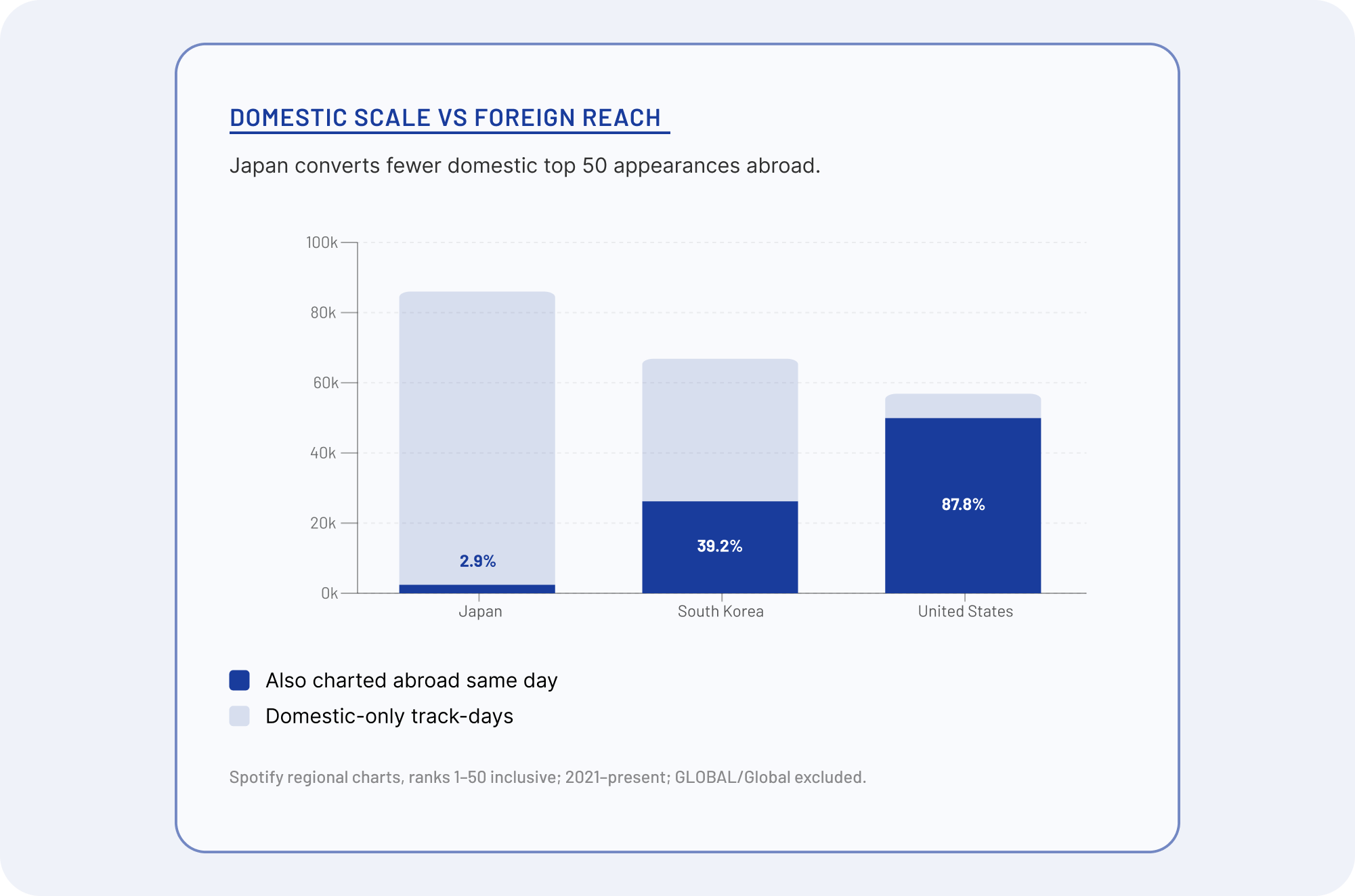
Japan has an enormous domestic music ecosystem, but comparatively little of that activity crosses its borders. Japanese artists accumulated roughly 86K track-days on Japan’s Spotify Top 50 between 2021 and 2026, but only 2.9% of those domestic track-days coincided with an appearance in at least one foreign market. For comparison, the figure was 87.8% for the U.S. and 39.2% for South Korea.
However, Japan’s path to globalization may extend beyond streaming alone. Anime, gaming, television, and online fandoms are creating pathways for Japanese music to reach new listeners, particularly across East and Southeast Asia. That shift is already visible among artists like Ado, YOASOBI, and Official HIGE DANdism, whose YouTube audiences have become increasingly international.
Brazil Is Building Superstars Primarily at Home
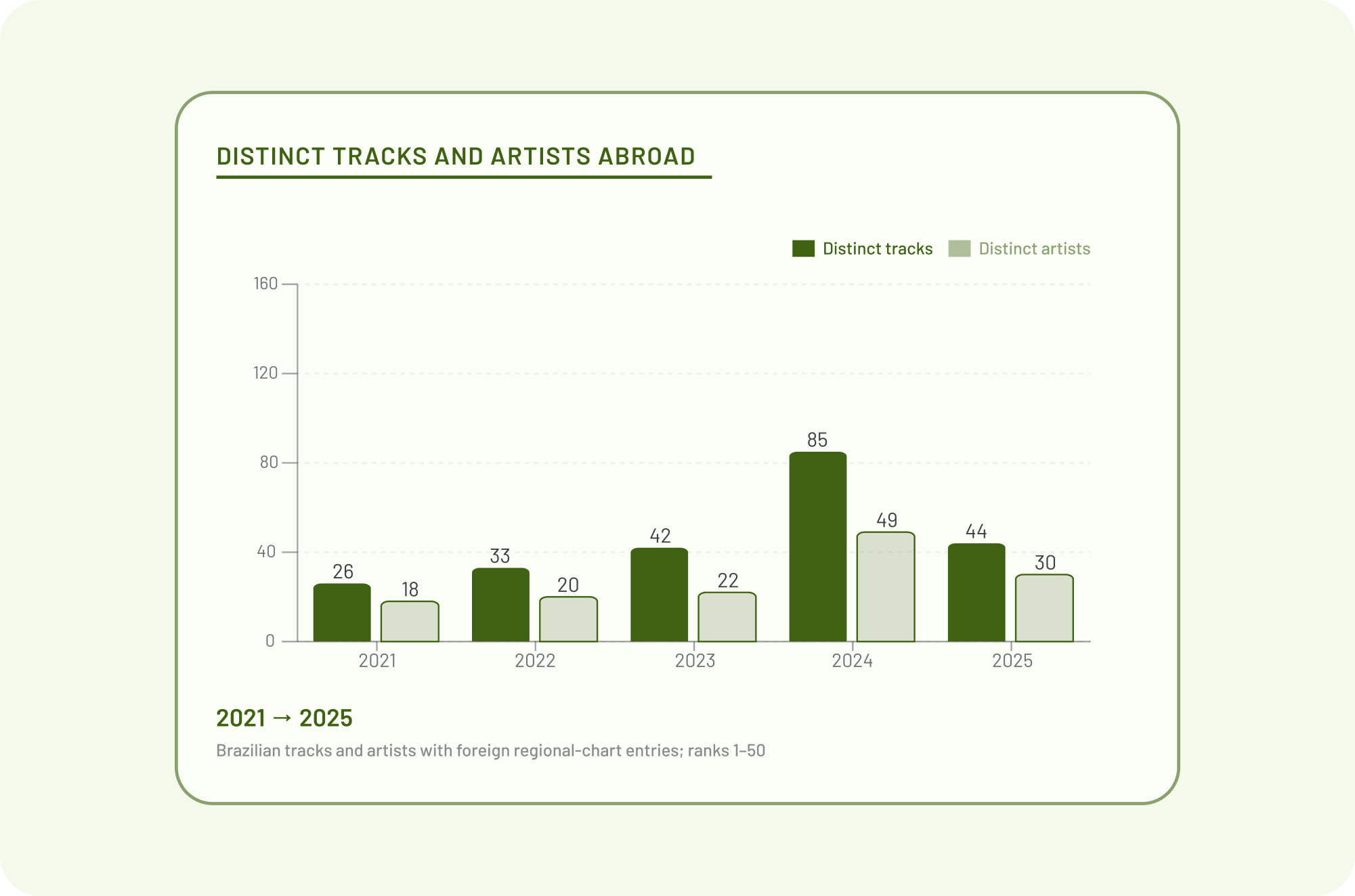
Brazilian artists’ foreign Spotify regional-chart entries fell 44.8%, from 1,622 in 2021 to 895 in 2025. At the same time, the number of distinct Brazilian tracks appearing abroad increased from 26 to 44, while represented artists grew from 18 to 30.
The result is a more fragmented international footprint: more Brazilian artists and tracks are reaching foreign charts, but they are appearing less frequently overall.
India’s International Music Footprint Is Growing Rapidly
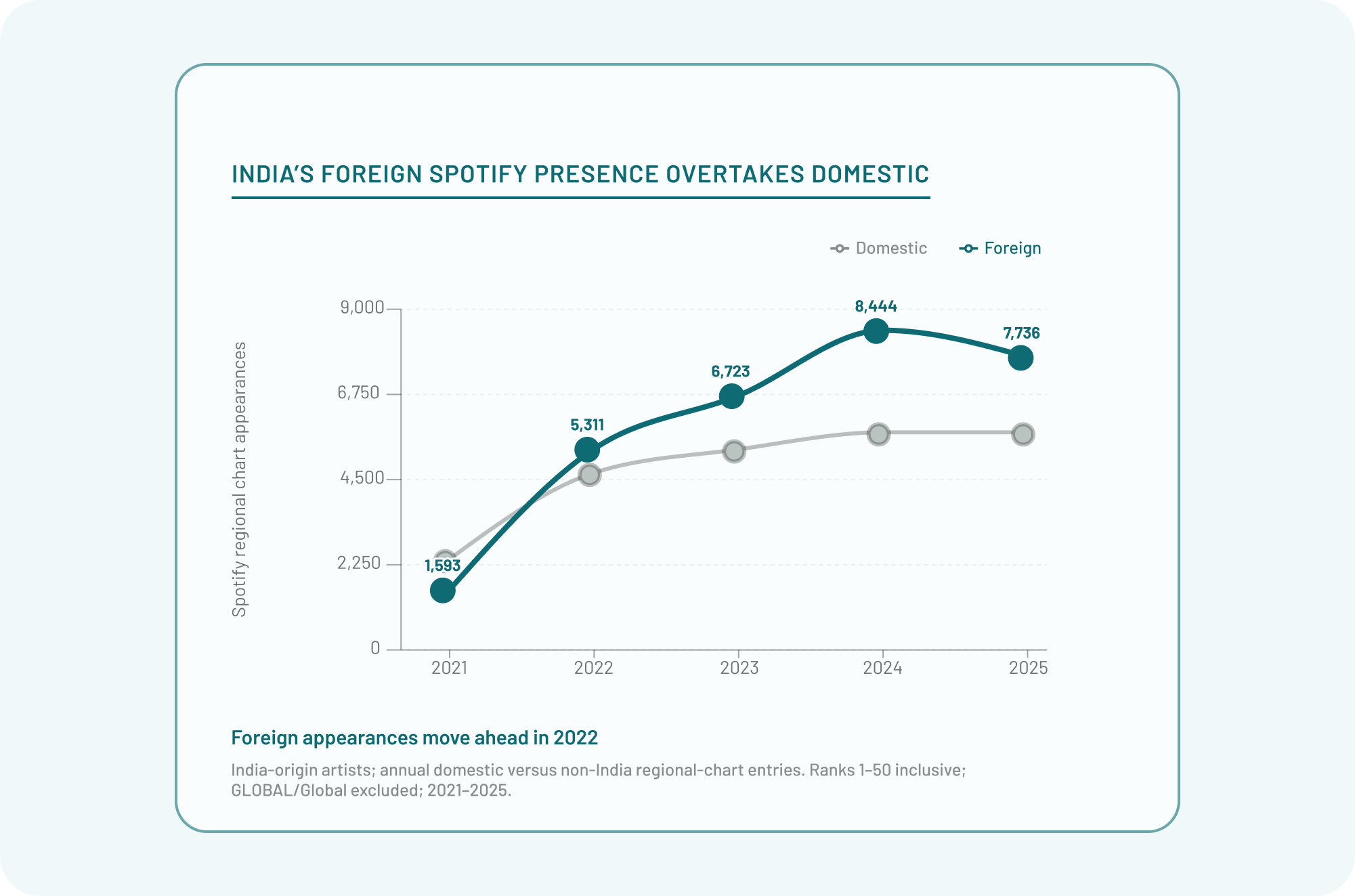
No country in our analysis has expanded its Superstar pipeline faster than India. The number of Indian artists reaching Chartmetric’s Superstar tier grew from 25 in 2021 to 154 in 2025 and 170 in 2026 so far.Its international Spotify presence has also surged. Foreign regional-chart entries increased from 1,593 in 2021 to 7,736 in 2025, after peaking at 8,444 in 2024.
But that international reach remains concentrated in a relatively familiar geography. Pakistan, the UAE, Malaysia, Singapore, and the Philippines account for much of India’s listening outside its home market, highlighting how regional connections and South Asian diaspora communities continue to shape the country’s international growth.
Nigeria Has Developed a Truly Global Music Network
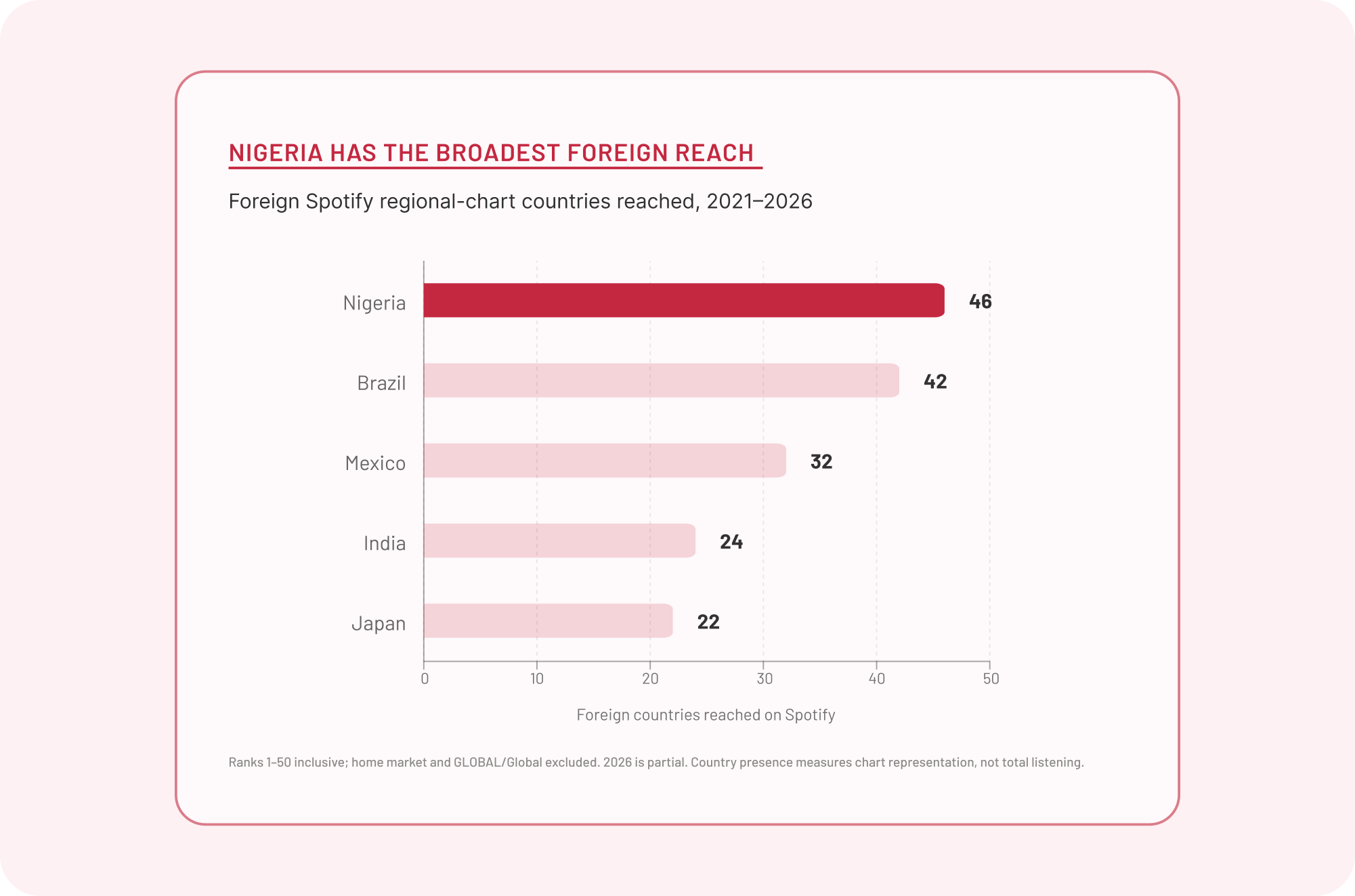
Nigeria stands apart for the geographic breadth of its international reach. Powered by Afrobeats, Nigerian music appeared across 46 foreign Spotify markets; more than Brazil (42), Mexico (32), India (24), or Japan (22).
The audience geography of Nigeria’s biggest artists reinforces that picture. In 2025, foreign listeners accounted for 97.9% of CKay’s YouTube audience, 93.6% of Rema’s, 91.7% of Burna Boy’s, 90.9% of Tems’, and 89.7% of Ayra Starr’s.
There Is No Single Blueprint for Global Music Success
Taken together, these five markets reveal how difficult it is to define what it means for music to be truly “global.”
Mexico’s growth is deeply regional. Japan is beginning to translate domestic strength into international fandom. Brazil is exporting more artists and tracks internationally but at a slower rate. India is expanding rapidly but remains geographically concentrated abroad. Nigeria has developed an audience network spanning dozens of markets across continents.
These differences show why international success can’t be measured through a single metric. Foreign chart activity, audience geography, domestic demand, cultural connections, and the longevity of international listening all help reveal how, and where, music is actually traveling.
Dive deeper into the data and discover the different paths music is taking across borders in Chartmetric’s full The New Sound of Global Music report.