
Music has always been at the forefront of globalization, notably with the cultural ripple effect of rock and roll starting in the 1940s. Music is transient by nature, and now more than ever this has lent itself to its expansion into a true globalized commodity.
For all of the complexity this causes – particularly for music when it comes to its status as a digital product, for better or for worse – one could say globalization has created more opportunity for artists to share their work independently, and for audiences to circulate music widely, with factors like culture and geographic location becoming relative non-issues.
It has also meant an artist anywhere in the world could become popular anywhere else. It is entirely possible that a song recorded in Tokyo could blow up in Mexico City.
The extent to which globalization has impacted the market becomes pretty clear when looking at recent data on audience distribution. Out of the top 500 artists by Chartmetric score, the majority (69%) have a global audience (their #1 audience is outside of their home country). The most common #1 country is US (68% of artists), followed by MX (8.7%) and IN (8.5%).
Some notable examples include Taylor Swift (US) and Justin Bieber (CA), whose main audiences are in Bangkok; Bruno Mars (US) who has his largest audience in Jakarta; Drake (CA) who is most popular in London; and Coldplay (GB) and Bad Bunny (PR), who have thriving fandoms in Mexico City.
Stats for these top artists also strike similarities among the most common Top 500 non-domestic audience cities overall. Mexico City is the top non-domestic city for 151 artists (30%), London at 105 artists (21%) and Jakarta at 45 (9%) — with Brazil, Australia, South Korea and Thailand as honorable mentions.
For many artists, any excitement about the possibilities is likely to be accompanied by a sense of uncertainty and pressure, especially if there is an expectation to “think globally” before they’ve even really started.
Breaking through market saturation, catering campaigns to different regions, and maintaining an active digital presence while retaining one’s artistic identity are just some of the other things that full-time artists may be expected to consider from day one.
In a globalized world, is it possible for artists to make music on their own terms? Depending on who you ask, the answer may vary. Most would probably agree, however, that it doesn’t happen randomly.
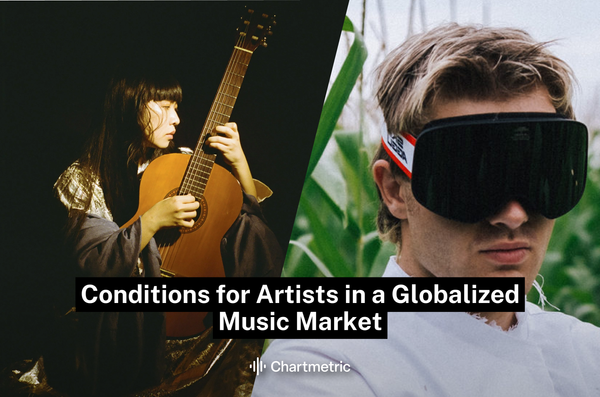
Here, we’ve attempted to unpack the careers of three artists that have successfully broken into the global market, in what appears to be (at least from what we can tell) from a place of autonomy and creative drive.
Ichiko Aoba and her mystically global base
Avant folk artist Ichiko Aoba enjoyed local fandom in Japan before making her big global break during the pandemic.
“The timing of everything has been really key, and that’s just something you can’t plan,” Aoba’s manager Mark Meyer told Chartmetric. “Ten years ago it wouldn’t have happened. The kind of music she makes and her universal appeal is paramount.”
Aoba has always had a ‘less is more’ approach to everything, Meyer told us. Her minimalist music, which is little more than her voice and a guitar, has also translated to her aesthetic and organic nature of her appeal.
At the time of its release in 2020, Aoba’s acclaimed album Windswept Adan started gaining traction on user-based platforms like TikTok, leading to online reviews from high-profile critics like Anthony Fantano and front covers in magazines like Line of Best Fit and Songlines.
Aoba has since fostered an incredibly balanced global audience, with listener demographics distributed between countries with a maximum 1.5% differences between top cities.
Aoba’s top five cities alone — Osaka, Los Angeles, Santiago, Jakarta and Mexico City — span across four different continents.
Age and gender demographics of Aoba’s fans are similarly diverse, with substantial listenership across the ages of 13-44, as well as male and female listeners split close to half and half.
The artist is currently on her 60-date “Across The Oceans” tour of recent album Luminescent Creatures, and has played or will play shows every month from June 2024 to May 2026.
Although the majority of her fans are not Japanese speakers, this has not seemed to deter her audience from being interested in her lyrics. Meyer believes it has lent to her appeal.
“I think people get into Ichiko because she’s different. And the Japanese thing is just another reason for them to delve into the meanings. It’s all a bit mysterious,” said Meyer.
He also noted that Aoba’s virtual lyric book translating all of her Japanese lyrics to English is one of her best-selling merchandise items.
At her live performances this year, Aoba’s team also offered free stickers to fans as shows in return for signing up to her mailing list, through which Aoba received 5,000 new contacts on her US tour alone.
The artist has also fostered a sense of community through her fan club Atóllba, through which the members or “islanders” receive monthly audio and video content, exclusive messages and forum access and behind-the-scenes footage.
“[Aoba] wants to be closer to her audience, as close as possible,” described Meyer. “And we do that through things like the fan club.”
"Who the f listens to Ski Aggu in America???"
…German music news site Hiphop.de is asking. “Offenbar gar nicht so wenige.” (Apparently, quite a few people).
The Berlin-born schlager/party/techno rapper got his start on SoundCloud in 2018 before breaking into the mainstream in 2022 with “Party Sahne”, which would become one of Germany’s most-streamed singles that year.
While the lion’s share of Ski Aggu’s audience is in Germany and the bordering German-speaking countries of Austria and Switzerland, the artist also managed to make his mark in the US in spring of 2025 with sold-out shows in all of his American tour locations.
Although the venues were small at around 300-600 capacity, the prospect of a US tour — let alone a sold-out one — is basically unheard of for an artist who raps in German.
Ski Aggu also played Portola Music Festival in San Francisco in September, alongside big headline artists like Christina Aguilera and LCD Soundsystem.
So what has made Ski Aggu so translatable to an English-speaking audience? His recognizable image certainly doesn’t hurt — giant, reflective ski goggles and a blonde mullet mirror the fun, wild and DIY vibe of both his music and presence on socials. The artist has been active on TikTok from early on, sharing song snippets paired with filmed antics like wheeling around on a stretcher in an unknown hospital.
@weristaggu
The artist or someone on his team is also putting in the effort to reply to comments and repost fan TikToks, as well as using German as a fun draw rather than a divider.
Ski Aggu has been known to teach German vocab on stage, and English-speaking fans have started to translate text online or start learning German to understand his lyrics.
In his partnerships with Smirnoff Ice and German shoe company Deichmann featuring exaggerated parody-like ads, Ski Aggu’s cheeky goofballing stands out, even to someone who doesn’t understand every word.
Bad Bunny is uncaged in the trap game
As the most-streamed artist on Spotify this year worldwide — not to mention three years in a row between 2020-2022 — many would argue Puerto Rican superstar Bad Bunny has more than earned his laurels as the ‘King of Latin Trap’.
An important feature of the artist’s career has been a steadfast devotion to his Puerto Rican roots and Latin heritage. Bagging five top 10 slots on Billboard’s Global 200, the release of Bad Bunny’s 2025 album DeBí TiRaR MáS FOToS was tied to Three Kings’ Day: a big holiday in PR and other Spanish-speaking countries.
@chartmetric @Bad Bunny’s Spotify monthly listeners evolution from 2019 until now. 📈🎧🇵🇷 What a journey! 🤩 #badbunnypr #badbunny #spotify #musicnews
♬ DtMF - Bad Bunny
Compared to some of the top albums of 2025, DeBí TiRaR MáS FOToS came second only to Lady Gaga’s MAYHEM when it came to Spotify playlist count.
As a part of his Cannes Lions Grand Prix-winning Tracking Bad Bunny campaign, the artist replaced DeBí TiRaR MáS FOToS song titles with coordinates in PR, showcasing parts of the country to reveal the tracklist. This allowed fans to come into the fold and experience Puerto Rico’s cultural beauty through the artist’s eyes.
What has made Bad Bunny so influential that he’s won Grammys, hosted SNL, sold 2.6 million tickets for the DTMF World Tour, and headlined this year’s Superbowl?
Albert Sergio Laguna, who teaches the course Bad Bunny: Musical Aesthetics and Politics at Yale, thinks the success of DeBí TiRaR MáS FOToS has to do with accessibility of sound across generations, as well as Bad Bunny’s demonstrating engagement with world politics.
“You have reggaeton that speaks to 21st century interests…but you also have salsa from the 70s, 80s and 90s…And he speaks to [issues like ICE racial profiling] directly in his lyrics, talking about issues related to migration…the question of tourism and what’s ethical and non-ethical tourism.”
Bad Bunny’s strong identification with his cultural heritage and consistent message of inclusion and unity — including his widely adored Super Bowl performance — sets the tone for a fixed identity that fans can resonate with and trust as authentic, even as different campaigns evolve with his artistry.
What these artists have in common
How have these artists of different genres, backgrounds and scales of fame all managed to thrive on the global stage? Perhaps the biggest and most obvious takeaway is that craft comes first. Even a perfectly planned and well-executed global campaign will fall apart if it isn’t built on a foundation of artistry.
If the goal is to foster and grow a dedicated global fanbase through online platforms, a strong visual identity also helps. Listeners are increasingly genre-, language-, and culture-agnostic, so the most important thing is to stay consistent.
Consider defining what will remain static about your identity (references, visuals, your artistic compass) and then experiment around those guidelines. Believe UK spoke about this in their panel at the Music Ally Connect conference in January, about their signed artist Adekunle Gold.
Only when artistry and visual identity are set in stone should artists consider fine tuning for different markets.
“I would suggest that you test stuff out, and rather than trying to tackle the whole world, just try to tackle it bit by bit,” Ichiko Aoba’s manager Mark Meyer told Chartmetric.
“And then sometimes, you work a cluster of markets. Benelux, for example. There's a lot of artists in the UK that do really well in Benelux, Holland specifically, and then that will sometimes grow to Belgium. It really depends on the music.”