
Artists can chase hits, but they can’t chase classics. By their very nature, classics emerge latent, and the litany of “one-hit wonders” proves that popular songs might not stand the test of time. Especially these days, as technology encourages fans to engage with music at a rapid rate. Every week, Spotify algorithmically updates Discover Weekly with new tunes, and short-form video content platforms expose users to only snippets of songs.
However, since these new channels have become established, some songs that were written as long as 50 years ago have sustained their immense popularity even in these new formats, revealing the true staying power of certain classics.
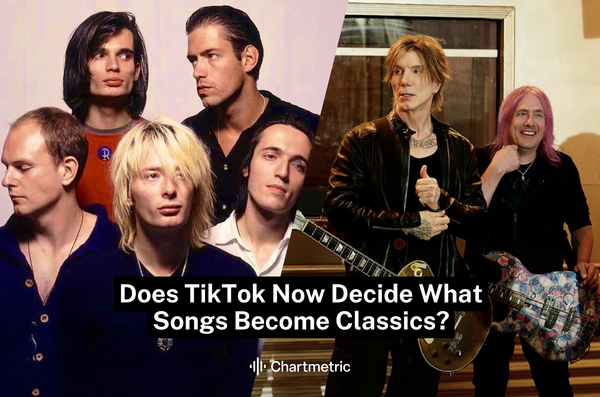
“Creep” by Radiohead, “Every Breath You Take” by The Police, and “Dreams” by Fleetwood Mac are among the classics that have been given a second life in the Spotify/TikTok ecosystem. At the time of writing this, “Every Breath You Take” has spent 68 consecutive days on the Spotify Top 50 Global Chart, re-entering Dec. 31st of 2025.
Some of these songs were surely propelled by topical factors such as a sync in Stranger Things or a notable death - “Running Up That Hill” and “No More Tears,” respectively - but these are one-offs compared to the 89 pre-2010s tracks that have landed on both charts. In fact, songs from the 1970s, 1980s, and 1990s collectively account for a substantial share of the overlap, suggesting that older catalog tracks continue to resurface organically.
Power to the People
To receive a second wind on newer platforms decades after release defines the idea of a classic. It’s very likely that casual listeners came across these hits on the Top 50 Global and had the same reverential reaction people had 30-40 years ago. Except now they can make TikToks, too.
Crucially, on TikTok, these impressive stats aren’t the result of short-lived dance trends or being co-opted by major influencers. The videos are diverse, and the follower count attached to some of the biggest videos is relatively modest.
The most popular video on TikTok for “Every Breath You Take” is currently sitting at 72.1 million views and 13.1 million likes. Yet it was made by a user with 17.1k followers. Two slots down in third place, the account has 1.8k followers, but the video has 30.5 million views and 5.7 million likes.
@12user131478 #girlfriend #boyfriend #missyou #love #sky #heart #fyppppppppppppppppppppppp #world #fypppppppp
♬ Every Breath You Take - The Police
The content in the top videos is just as varied. The #1 video depicts a tapestry of the cosmos with a caption that says “All this and we still met.” Seems pretty in line with the tone of “Every Breath You Take,” a fervent love ballad. But the fourth most popular video shows a cat digging its claws into a dog. Not as relevant. Furthermore, throughout the top videos, creators use a variety of snippets from these songs rather than relying on the same 15-30 second clip.
Given that the content of the video and the piece of the song being used is entirely in the hands of the user, streaming and short-form video platforms completely empower fans to impact a song’s success by stripping any sort of attachment between the music and traditional elements of the industry.
“We have dozens of songs every month. Some of them work on TikTok. Some of them don't. Then some of them surprise you. The audience has full control,” says Esmeralda Pham, Director of Creative & Fan Engagement at the independent label Thrive Music. She will often contract professional content creators to support marketing campaigns for releases, but their experience in the field doesn’t guarantee success.
“I’ll think, ‘This would be a good song for TikTok.’ We'll have a bunch of content creators on this campaign, and then it just flops. Maybe it's the day, maybe it's the algorithm,” Pham adds. “Everybody thinks that influencers and content creators are the answer, but they have to love it as much as you do.”
There is no way to measure why or how someone loves a song, but TikTok and its counterparts allow listeners to connect with that inexplicable quality more directly. Prior to this era, for a song to blow up because of visual media, some label head would often call a movie producer to get a high-value sync or invest millions in a professional music video. Now it just takes one random viral clip.
“Going back decades, songs become hits because they're paired with something non-musical: a movie, television show, MTV. TikTok is an iteration of that, except it's very bottom-up as opposed to top-down,” says Chris Dalla Riva. Dalla Riva is the author of Uncharted Territory: What Numbers Tell Us about the Biggest Hit Songs and Ourselves, a book that analyzes trends in every Billboard Hot 100 #1 throughout history.
Separation is Good
The bottom-up dynamic creates separation between the music itself and its methods of distribution and production. Moreover, the music evolves into a means of accessible creation. Using songs as creative tools on TikTok doesn’t require the intricate processes of getting a sample cleared or recording an entire cover.
Human beings often identify with their taste in music, and with short-form videos, they can express that taste in a new way with nothing but their phones. As songs gain traction on TikTok through these expressions, they translate into listening behavior, with many of the same tracks appearing on Spotify charts around the same time.
Some decry how this cultural and economic shift has affected music as a whole. But songs released before TikTok existed resonating so universally in this new format demonstrates how their unique ability to connect with the masses goes beyond any external details.
It’s fair to say that a significant portion of the TikTok users making videos with “Creep” (1993) and the Spotify users adding “Every Breath You Take” (1983) to their playlists could not name the year the song came out. But they’re not choosing them because they’re new or because they’re classics.
“The popularity of music becomes more divorced from when it came out. Sometimes it's not even songs that are that old. When Lizzo's ‘Truth Hurts’ started going viral on TikTok, the song had already been out for years,” Dalla Riva says. “Back in the day, that wasn't as common. You were pushing whatever the latest record was, and it was unlikely that, out of nowhere, something in your back catalog was gonna end up on the radio.”
Similar to how music is separated from its release date in 2026, music is also separated from the original artist. When “Dreams” came out in 1977, Stevie Nicks was an icon of the era and a huge inspiration to so many women who wanted a career in music. On TikTok, countless people discovered “Dreams” by scrolling past a guy riding a skateboard and drinking cranberry juice out of the bottle. “Dreams” was a #1 hit, but that success was never about Stevie Nicks. It was about the song itself.
A precursor to this idea can be found in the trap banger “Harlem Shake” (2013) by the Philadelphia-born electronic artist Bauuer. This song launched an early iteration of the TikTok-esque video trend on YouTube. The videos began with a room full of people where only one person is dancing, and then upon the drop, the whole room erupts into extravagant movement. Around the song’s release, these videos were all over the internet. Some of them have now cleared hundreds of millions of views.
As a result, Bauuer earned a #1 on Billboard’s Hot 100 chart, but he himself did not elevate to iconic status. The attention was on the song, not him, and because the song didn’t have that same enigmatic quality of the classics, it has now faded into the background of dance music history (Bauuer hasn’t released a trap song in many years either).
“Back in the day, when Madonna released a music video, Madonna was in the video. She has control of it. Whoever's watching is gonna associate that video with her,” Dalla Riva says. “But there are many trends on TikTok that have no association with the artist, again, because it is that bottom-up world.”
Classic to the Core
Without details like the artist or the release date coming into play, nothing is left but the pure artistic value of the song. Then, via the digital nature of Spotify and TikTok, these songs will see the same kind of charting results they saw upon their release. Either the streams will reflect in the charts, or a viral TikTok video will cause people to seek out the song on streaming.
Unfortunately, this analysis still proves the idea of chasing a classic is futile. There is a benefit for artists, though. It endows them with a greater freedom in creating. Common factors such as persona, song length, and current popular sounds are less important than ever. They might as well make music they love, and decades from now, their work could resonate with millions of people.