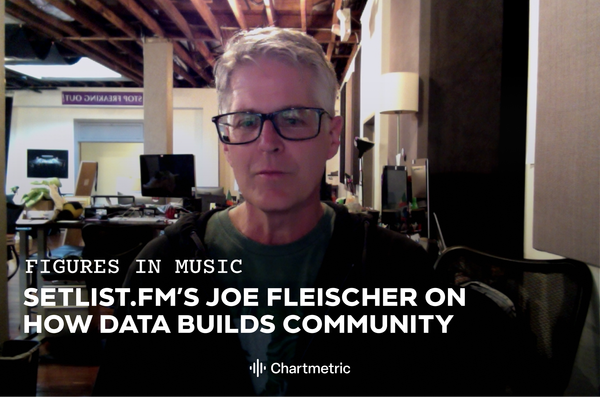

Joe Fleischer is the Publisher of Setlist.fm, “The Setlist Wiki.” At its core, the site provides the opportunity for music fans to see what songs an artist played at any particular show throughout history. This could be as recent as Oasis’s reunion tour last year or as far back as a performance by Wolfgang Amadeus Mozart in 1791.
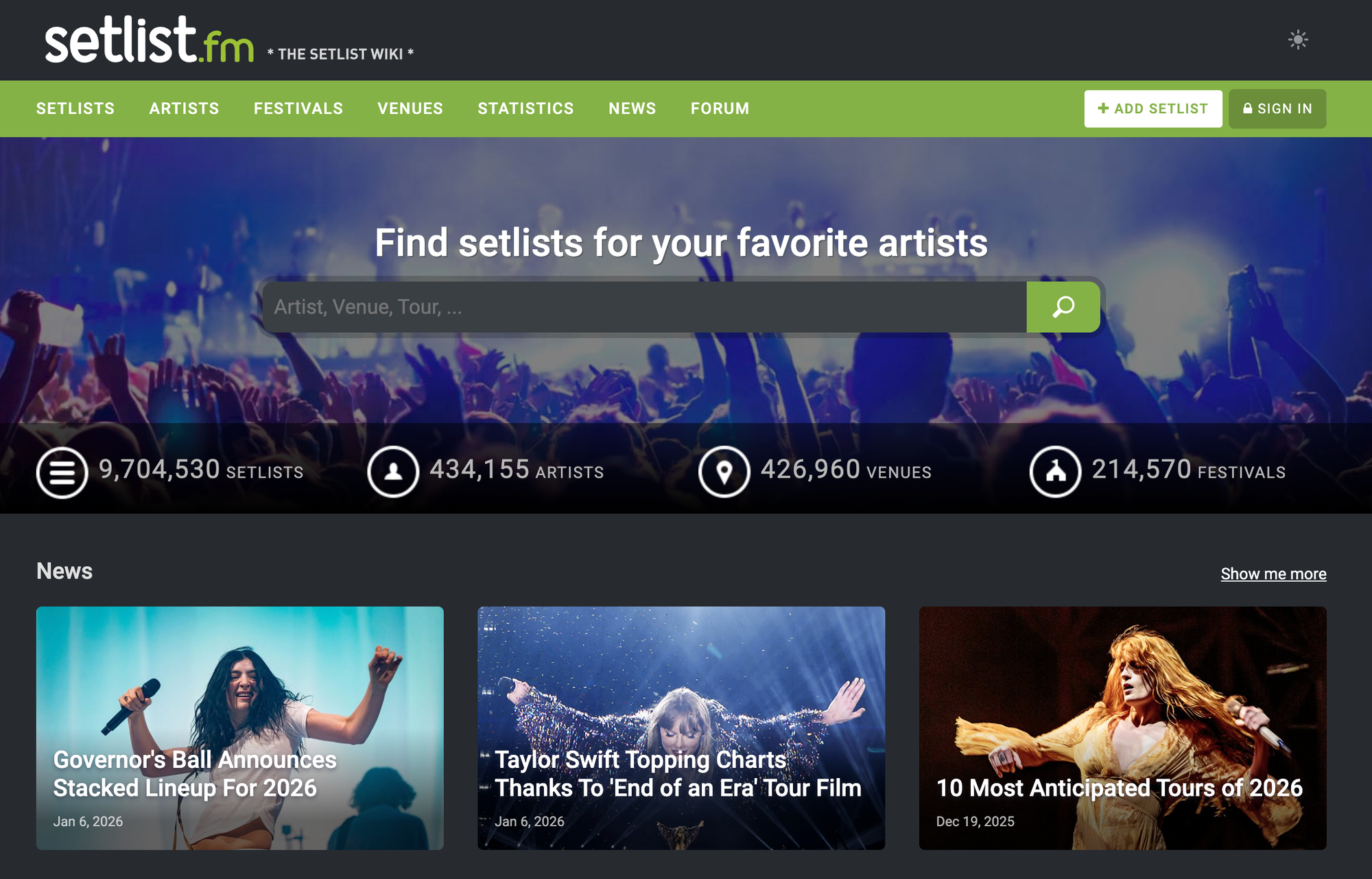
At the time of writing, the site hosts a total of 9.7 million setlists across 434k artists who have played at 426k venues and 214k festivals, but the numbers go up every day. All of that data is 100% user-generated by the website’s community of millions. Fleischer cites a figure of 12-13 million visitors every month, and The New York Times reported that the average visitor spends eight minutes on the site.
As Publisher, Fleischer simply monitors the overall output. This includes all the user data as well as the content in the Setlist.fm news section.
“A publisher in this sense is looking at how the community functions,” Fleischer says. “We try to bring all of the information, whether that's data-oriented information or content-oriented information, to the users to help them on their journey. We're always on our mission to be helpful to the concert experience.”
A core tenet of that mission is following the community’s lead. Every update to the site is based on an idea from the website’s userbase. One of the most recent was in 2021, when Fleischer and the team started adding set times to each show. Other updates allowed users building setlists to create annotations denoting bits of information, such as if a song was debuted during the show or if the artist moved to a B-stage for part of the performance. The site also offers comprehensive artist profiles that track data points such as the total number of times they’ve played individual songs and maps of all the countries where they’ve performed.
“I'm fond of saying that, as the team that operates the site, we've never had an original idea. They've wanted us to find a way to triangulate the data around a show. Not just the setlist, but other things that can bring value to the community,” Fleischer says. “We try to be people who respond to a really vibrant community. The numbers are just mind-boggling now. We just try to serve them.”
Read on to see how the community engages with Setlist data, how the data benefits artists, and what trends Fleischer is seeing in setlists as a whole.
Given everything is user-generated, how accurate would you say the data is across the website?
Really accurate. The thing about Wikis is that they're self-cleansing. The community's engaged. Here’s a personal example. A couple of years ago, I went to a performance in Vegas, at the Bowery called An Evening with The Church. I'm trying to add songs to the setlist in real time. And as I go, I realized I got one wrong. Within a couple of minutes, some other community member corrected my mistake.
I cannot even tell you how many people were in that room with their phones out, occasionally adding and posting to Setlist. If there's something that a member of the community gets wrong, someone will fix it. That's always been the case.
What are the benefits of relying on user-generated data vs. gathering the data like Chartmetric does?
Setlist is about the community working together to produce something that's helpful to everybody. It's a community that's really passionate about music. There's a lot of love and care that goes into the stuff they contribute. Is a band playing my favorite song on this tour? Are they tending not to? When are the set breaks? What can I expect from encores?
Last year, Oasis was an event. The amount of people hitting the page at the same time was just astonishing. So, what's great about it is that we're so consumer-focused that we're just trying to help people who are there and those who are following along at home connect to that show.
So I think it's a very different path. A company like Chartmetric usually receives data sets from multiple sources and then does a great job of synthesizing them into business intelligence. That's a tremendous service.
Setlist also aggregates other data points like touring maps and set breakdowns by albums. Does the community engage with those just as much as the setlists?
For any artist who has multiple albums, people are always seeing what the band is playing from their most popular. How many hits are they gonna hear versus deep cuts or recent releases?
There was an Iron Maiden tour a few years ago, mostly in Latin America, and they were playing all the new music. The community was like, “Hey! Where's the stuff from Power Slave? Where are these classic songs from the Paul Di'Anno days?” It became a really interesting discussion, because people really want a balance of this music.
We've heard artists say that helps them think about their setlists. “Last time we were in this city, we didn't play these songs. We gotta make sure to play some of these fan favorites.” And so they use Setlist to help them construct setlists all along the tour.
Have you seen any interesting trends across setlists in general? Maybe more or fewer songs?
One thing we're seeing is that the encore is taking a different shape. So instead of the bands always leaving the stage in a ceremonial way and then returning to play an encore, we're starting to see bands building setlists in sections. Almost like chapters. They're really being thoughtful about the last three songs of the set.
That's interesting to us, because it's been very traditional. Here's the setlist, here's a break, and then here's the encore. It feels like that's dynamic and changing. Something socially is happening around encores, and we're beginning to study it.
At what point in their careers do artists generally get the attention of the community and have all their setlists filled out?
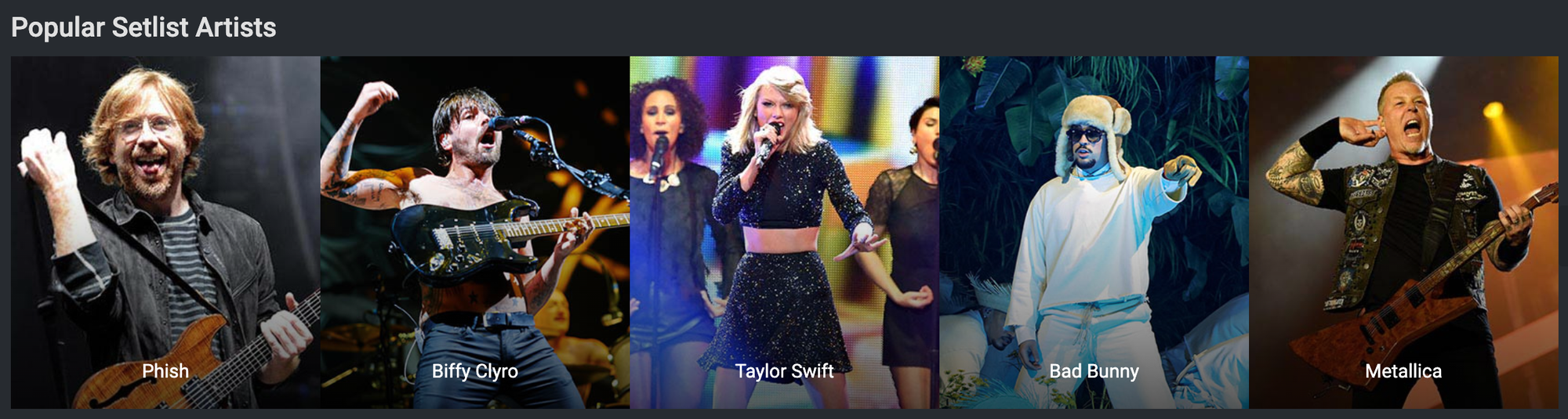
It's a tough question. There's a lot of editorializing there. The thing I would say about Setlist is that even the smallest neighborhood bands have their fans who are posting setlists. So, it's always surprising to me. The community serves the biggest tours in the world. Taylor Swift. Coldplay. Oasis. Beyonce. Those fans are gonna be there. But really obscure, small, local talent is well represented.
Our goal is that every show is getting recorded to the site. It would be hard to say that there's some sort of tipping point, because I don't think setlist works that way. Setlist is such a long-tail animal. I'm really hopeful it's just everybody.
Why do you think users are drawn to filling out these setlists?
I don't even know if I'm the one to try to sum up what their passion is. But I think the basic underlying theme is that, when you love an artist like that, you want to engage with them in all the ways that you can. Being part of archiving that history is a really enjoyable, fulfilling thing for a fan to do. You're helping other fans. The artist gets a lot out of Setlist.
That's really always been the goal. What are the things that Setlist can do to just continue to make that experience even better?