
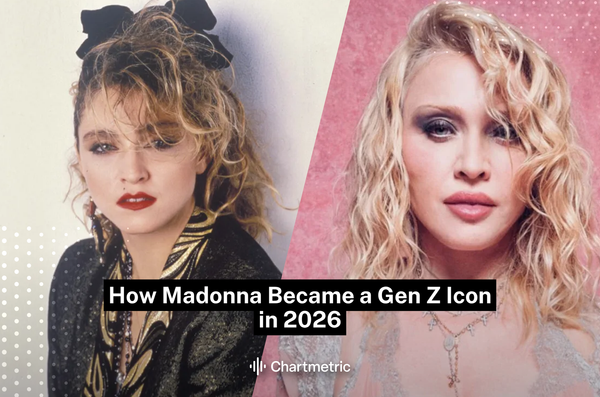

The '80s are back and Madonna's catalog fits right in. The catchy beats and addictive hooks are soundtracking TikTok edits, almost like it was made for it.
The act of reinvention cannot be discussed without mentioning Madonna, whose artistry has punctuated every decade since her debut in the '80s. This one is no exception, though the decade itself is an interesting variable: divisive, future-forward, and in love with its own risk. Everything, in other words, she was already doing. Fittingly, her new era circles back to one of her most beloved risks: Confessions II, out now, is a direct sequel to 2005's Confessions on a Dance Floor — an album that itself was a love letter to the disco-pop sound of the very decade now having its moment.
The '80s are having their moment across the board, and at first glance, her catchy beats, soundtracking reels and TikTok edits look like a natural fit for a decade-defining icon. But there is more to this resurgence than what meets the eye. What is causing specific acts from the '80s to have such a moment?
From here, the data tells the rest of the story.
A Generational Run
A useful place to start is Coachella this April, where one of the festival's headliners, Sabrina Carpenter — whose original artwork for Man's Best Friend drew its own round of criticism — brought Madonna onstage to perform "Like a Prayer" with her. The collaboration made the argument on its own: a young pop star being called provocative in 2026, standing beside the one who spent the '80s inventing the blueprint.
The impact showed up in the data almost overnight. Madonna's Spotify monthly listeners rose roughly 33 percent between February and August, climbing from a flat baseline to 55.6 million. Her streams surged sharply in mid-April, around her Coachella appearance with Carpenter and the April 30 release of her single "Bring Your Love." They climbed again later in July with the full release of Confessions II, and following her performance at the first-ever FIFA World Cup halftime show.
Post-Coachella, "Like a Prayer" has been used in 564,774 TikTok videos — up 319 percent over the past year, with sound usage tripling within days and holding at that level through the summer. Her entire catalog saw the same lift.
In her catalog, the ‘80s dominate the most-streamed tracks, as expected, accounting for 4.29 billion of those streams. But later records are sitting among them. “Hung Up”, from 2005, has drawn 725.7 million Spotify streams ahead of “Like a Virgin”, “Vogue" and “Into the Groove.” While largely tracking from the ‘80s, the standout pattern among her most-streamed tracks is tempo: they are upbeat dance numbers. Her ballads, several of them among her best-known ones, sit an order of magnitude below.
Old Songs, New Life
Madonna's catalog appears on roughly 1.27 million Spotify playlists, and how that reach breaks down tells its own story. Spotify's editorial team controls about 831k of those playlists, which together reach 177 million listeners, 43% of her total playlist reach. The remaining 57% comes almost entirely from user-generated playlists, which reach an even larger audience of roughly 240 million listeners.
That user-generated growth isn't confined to eighties or throwback playlists; it spans moods and activities of all kinds, and it's been climbing steadily since last year. In other words, her Coachella appearance and album release alone didn't create this momentum. Rather, they boosted an already solid foundation.
The contrast becomes clearer looking at how each side categorizes her: Spotify's own editorial playlists overwhelmingly frame her as a legacy act, with 83% of the reach for her older records coming through decade-based playlists like "80s Hits" or "Throwback Jams." Independent curators make no such distinction. They sort her music by mood and use instead into playlists like Belting Songs, Catwalk Runway, and White Girl Bangers. These aren't necessarily nostalgia categories. They're contextual, current, and the kind of playlists younger listeners would be more inclined to reach for.
Young & Global Ears
Chartmetric's audience data suggests most of the people listening to her eighties catalog weren't even alive when it came out; around 66% were born after "Vogue" was released in 1990. It's worth noting Chartmetric's data draws from social platforms that skew younger to begin with, which may account for some of that gap. Still, The 45-to-64 age band, the people who were teenagers or twentysomethings during her Like a Virgin and True Blue era, makes up just 9% of her current consumption.
The growth is global, too. Brazil is her second-biggest market in the world, ahead of the UK. Mexico ranks fourth, ahead of every European country on her list. Combined, Latin America accounts for nearly 28% of her global audience, more than the US on its own.
For anyone encountering Madonna as a viral sound rather than a full discography, that geography isn't coincidental. A significant part of it traces back to "La Isla Bonita," her 1987 track sung partly in Spanish, which has racked up 778 million streams on Spotify to date. On TikTok, videos using the song have grown roughly 112% in the last three months and even the audience data for that single track echoes the same Latin American skew.
Catalog Revival
What is happening to Madonna's catalog this year is larger than the release of Confessions II, larger than the Coachella stage, larger than any collaboration with a younger artist. Her resurgence sits inside a broader cultural exhaustion — with the algorithm, with AI-generated slop, with platforms pushing what they already know you like. The generation raised inside this digital echo chamber wants proof that the work came out of a real person's hands.
Which is why the recent rise of analog activities makes sense: vinyl listening sessions, film photography, and, by extension, artists who embody that same intentional effort. The paradox is that the discovery is happening on the same platforms that produced the fatigue.
Perhaps this collective reminiscence of retro sounds is beyond nostalgia, and more of a request to the music industry. The audience is asking for artists whose body of work still carries the marks of authenticity. Madonna's resurgence in 2026 is not a surprise. Her catalog is wide enough to fit any context, and her refusal to be boxed in is the same instinct the current digital landscape rewards. This decade will pass. Machines will keep reinventing themselves. So will the Queen of Pop. And whether we look forward or back, her legacy of relentless reinvention will remain the only constant.