
When Ian Harrison, CEO of the American Association of Independent Music (A2IM), spoke at the organization’s GRAMMY breakfast a few weeks ago, he proudly proclaimed that 50% of all nominations for the 2026 awards came from the independent sector.
“We used to not get invited to these things, and now we get to throw parties with them,” Harrison said to the crowd with a laugh.
A2IM is a leading trade organization representing the interests of the independent sector on a national and global scale. Over 600 independent labels are members, including power players such as Secretly Group and EMPIRE. The organization also partners with major industry companies such as Chartmetric, Spotify, and BeatBread.
A2IM’s advocacy work has led to national legislation being passed, including the HITS Act, which allows independent artists and producers to write off up to $150,000 in recording costs per year.
Harrison started his role as CEO of A2IM in October 2025. Prior to this, he was Executive Vice President of the longstanding punk label, Hopeless Records. He also sits on the board of SoundExchange and Copyright Alliance, two more organizations dedicated to supporting individual creators.
Needless to say, Harrison has years of experience in the independent music industry as well as unwavering dedication to supporting independent artists and labels, which he is now bringing to A2IM.
“The independent community is the right place for the most interesting artists in the world,” Harrison tells Chartmetric.
Read on to learn about the core principles of A2IM, how the organization is approaching the AI revolution, and how A2IM is supporting its community with data.
How would you describe the mission of A2IM?
Our organization is fighting for the independent needs in America and around the world. The majors have the RIAA and other organizations that are constantly fighting. Every bill that's being considered in government is gonna have a person from the major labels advocating. Without an organization like A2IM, we don't have a seat at that table. We don't have that lobbying team that can go in there and say indies are different.
We're able to get stuff done in Washington because we have a different proposition than most major labels. Major labels are headquartered in three cities. We have members in basically every state and tiny cities that are important to local politicians and local music programs.
There's a unique power to the indies, and A2IM is really the main organizing body that can tell that story in a government sense, but also in a commercial, networking, community-building sense.
Who are some independent artists that you're really excited about at the moment?
I'm excited about a new entrant to our world, Hayley Williams, who is working with Secretly, a big partner of ours. She scored some Grammy nominations. She'll hopefully do quite well in our awards show coming up. It's one of my favorite stories.
As someone who comes from that genre and saw her lifting up small artists even though she was on a major label, it's exciting to see her have her own thing now.
You have radio charts on your website, including college radio. That’s a good idea because it demonstrates how music is resonating with the youth, and college stations aren’t required to play what’s in the top 40
The mainstream might not always find value in these things, but the partners we have do. Coming from my own subculture and subgenre, it mattered to me that artists hit certain charts that I'm sure a major label person would not care about at all.
It's not nothing for some of these accomplishments to be communicated, and I think college radio is a great example of that. There's a whole ecosystem for breaking artists there, and there are genres where it's super important for them.
Are you working on sharing more forms of data?
I generally feel that we shouldn’t be launching tons of stuff that we can't keep up with, and has uncertain value. So, we're a little cautious about launching tons of different charts. I'd rather point to something that Chartmetric is publishing. But we're always interested in partnerships that can lift up an interesting stat to the indie community. Radio is one of those spaces where indies are historically disadvantaged, so that's one area where we can help.
Now majors and indies can use the same data tools, which can empower newer artists and labels.
One of our core missions at A2IM is to help independent music businesses stay independent, and that means a lot of different things to different people. But what's crucial is if you're going to be independent, you need access to these tools. There's a whole suite of them. Data tools, distribution services, partnerships.
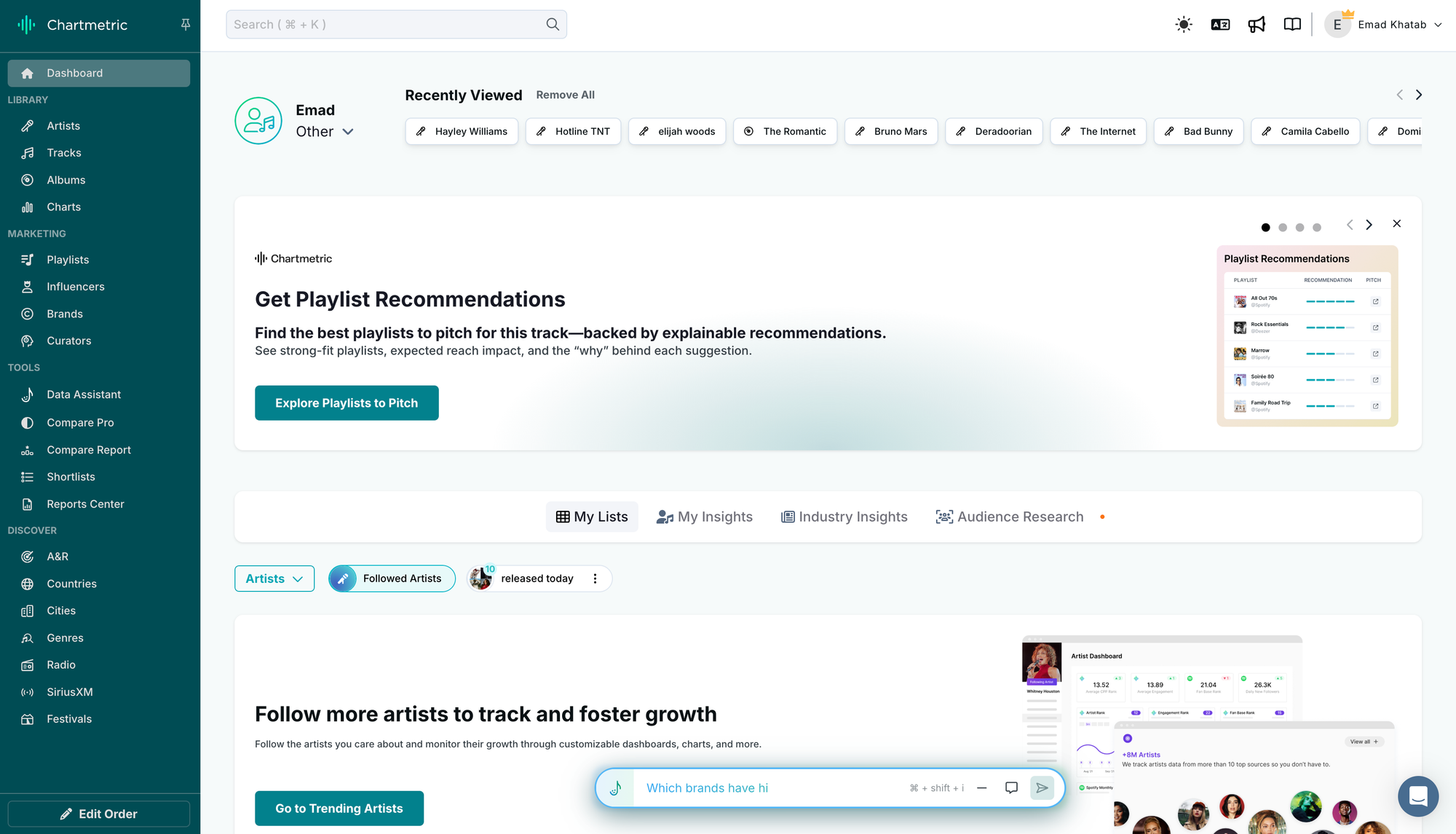
So if you want to stay independent and do things on your own terms, you need these types of partners. You need an easy way to understand data, so Chartmetric’s offering is crucial to the marketplace. There's so much data coming in. What can I do to wrap some context around this?
You say you want independent artists/labels to stay independent. Why is that?
We want people to stay independent if they want to. This is not an “against your will” community. We believe in the independent music sector. I come from that world. Everything I value has come from that space.
The main mission there would be to make sure that people aren't forced into situations. In the past, if you wanted to be in record stores, you had to be distributed by a major label. Over time, those options opened up. What it means to be indie will always be changing, and the flexibility you have will be based on what's out there in the market. We make sure that flexibility is at its maximum.
What is A2IM doing to support indies as AI becomes more powerful?
A2IM’s not here to push anyone into a position on this transition, but we have a lot of important questions to answer, and not a ton of industry leadership and understanding right now. It's gonna be our mission to understand this space, create relationships, and help our labels navigate. Whether that be, “I don't want anything to do with this. Help me opt out as much as possible,” all the way to, “I love this. Help me create relationships and figure out how to do this.”
I've started to speak to a lot of these companies, and there's plenty of stuff going on there that I don't love, but I've had great conversations with people who are at least saying some of the right things and want to build tools that are interesting.
We’re here to make sure that AI companies, as they're developing these products, are doing it right, and they know what we value. Their tools are only gonna be interesting and powerful if they lift up the best part of what music already offers.
If we look back at streaming, it didn't end with, “Here's how I can get all the music for free.” It ended with, “Here are some companies that really married access with a delightful experience.” My hope is that's where we end up with the AI companies, and that's what we're trying to build towards with the ones who want to be in that headspace. For the ones that don't, we're here to go to battle.
What do you think would happen if all the indie labels and artists disappeared overnight, and we were in a music industry run entirely by majors?
In terms of the best parts of music: lifting up interesting stories, communicating experiences from parts of the world you would never know about. That's the stuff I like about music. That would take a big hit. There are great artists on major labels, so I'm sure there'd be some, but it would be a significant blow to world culture.